Porsche 911: Sixty Years, Eight Generations, and a Silhouette That Has Never Bent
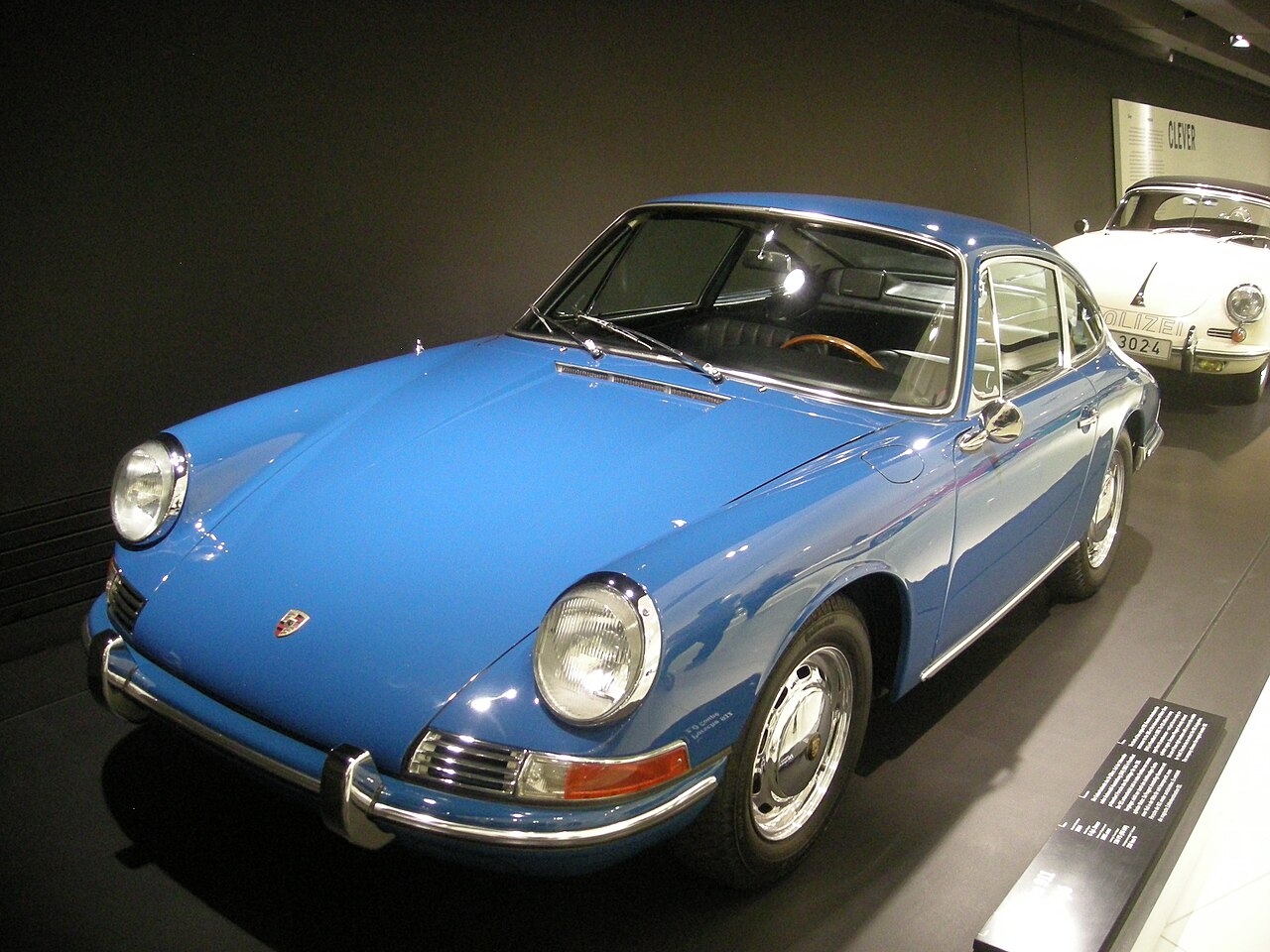
There are few industrial objects that can be recognized at first glance, from a three-quarter angle, in a rearview mirror, from a hundred meters away. The Porsche 911 is one of them. Since 1963, almost everything about it has changed — displacement, chassis, electronics, cooling — except for two things: its silhouette, and that flat-six engine mounted in overhang behind the rear axle. Eight generations have come and gone, and yet the latest still visually converses with the first. In the hands of any other manufacturer, this stubbornness would have turned into a joke. At Porsche, it became a signature.
A birth under the wrong number
Unveiled at the Frankfurt Motor Show in 1963, the car was originally called the 901. Peugeot argued that it held the rights, in France, to three-digit names with a zero in the middle. Rather than fight it out, Porsche swapped the zero for a second 1, and the 911 was born. Under the rear hood purred an air-cooled flat-six, an architecture as unusual as it was stubbornly persistent: the engine mounted behind the rear axle, a notoriously tricky recipe that Stuttgart's engineers would spend sixty years taming rather than abandoning.
The air-cooled golden age
Heir to the 356, the 911 debuted in 1964 with a two-liter six-cylinder engine producing around 130 horsepower: modest on paper, but already remarkably well-balanced. The original, produced until 1973, went out in style with the Carrera RS 2.7 and its "ducktail" spoiler, which cemented its sporting image for good. It was succeeded by the G-Series, from 1973 to 1989: this second generation saw the arrival of the 911 Turbo — unveiled in 1974 for the 1975 model year, with its now-iconic "whale tail" spoiler — as well as the bellows-style bumpers that, starting with the 1974 model year, met American low-speed impact standards. Next came the 964 in the late 1980s: beneath an almost identical body, it was eighty-five percent new, introducing power steering, ABS, and, on the Carrera 4, the first-ever standard all-wheel-drive system on a 911. Then came the 993, from 1993 to 1998, which many consider the most beautiful of them all. It was, above all, the last to breathe open air: after it, the flat-six would switch to water cooling.
The turn that nearly broke everything
In 1997, the 996 broke the pact. To survive financially, Porsche shared its front end and part of its mechanicals with the new Boxster, and above all, swapped air cooling for liquid cooling. Purists howled, mocked its "fried-egg" headlights, and mourned the vanished roar. They were wrong on one count: this unloved 911 played a decisive role in Porsche's turnaround — alongside the Boxster, with which it shared its front end, doors, and a host of components, and thanks to a deep industrial restructuring led by Wendelin Wiedeking. This shared-parts strategy slashed costs and pulled the brand out of a critical period.
What followed reads like a long redemption story. The 997, in 2004, brought back the round headlights and softened the car's design. The 991, in 2011, grew longer, became more composed on the road, and, starting in 2015, saw the Carrera models switch to turbocharging — while the GT3 stayed true to the naturally aspirated engine. The 992, finally, launched in late 2018, digitized the cabin, beefed up the chassis, and in 2024 even introduced, with the Carrera GTS, the first-ever hybrid 911 road car in history. At every stage, the silhouette tightens a little, widens a touch, but never betrays itself.
The secret of a shape that never ages
How can a car remain itself for sixty years? Because Porsche understood early on that the 911 wasn't a style, but a proportion: that plunging front hood, those fenders rising above the headlights, that roofline sweeping in one unbroken line to the tail, that mass settled over the rear. You can enlarge the wheels, slim down the lights, widen the track — as long as the proportion holds, it's a 911. In-house designers speak of a DNA that evolves in small touches, never through rupture. The result is unique in the automotive world: a lineage in which every generation visually converses with its ancestor. Porsche, in fact, celebrated its millionth 911 in 2017 — proof that a shape faithful to itself never held back success.
What remains is the uncomfortable question: how far will this lineage go? The combustion flat-six is living out its final golden years, an electric 911 looms on the horizon, and one wonders whether the silhouette will survive the disappearance of the rear engine that shaped it. If the story of the first eight generations teaches anything, it's that Porsche will find a way to change everything so that nothing moves. The 911 already survived water; it will probably survive the plug.
Want to learn more? Find all the Porsche 911 brochures available for free download on Brochure Auto.
Gallery
Photos © leurs auteurs / Wikimedia Commons (CC BY-SA 4.0)
- https://fr.wikipedia.org/wiki/Porsche_911
- https://en.wikipedia.org/wiki/Porsche_911
- https://newsroom.porsche.com/en/2019/history/porsche-klassik-911-eight-generations-dna-18914.html