Vauxhall, the British enigma: an Opel with a griffin that never crosses the Channel
Anyone who has ever driven across England knows that strange feeling: the car parks are full of cars that look remarkably like Opels, yet carry on their grille a small red griffin and a name unknown on this side of the Channel, Vauxhall. Here, the brand simply doesn't exist in showrooms, even though it holds a prominent place in many brochure collections. It's a paradox worth lingering over, because behind that badge lies one of the oldest car brands still in operation, and one of the most puzzling.
One of the oldest British brands
The story begins in 1857, long before the automobile, when a Scottish engineer named Alexander Wilson founded a factory for pumps and marine engines in Vauxhall, a district in south London. The first car didn't appear until 1903, a modest five-horsepower single-cylinder model steered by a simple lever, with no reverse gear. The business gradually shifted toward automobiles and took the name Vauxhall Motors around 1907.
The famous griffin that still adorns the grilles is no marketing gimmick: it comes from the medieval coat of arms of Fulk le Breant, a lord whose London estate, "Fawkes Hall," eventually gave its name to the Vauxhall district, and later to the brand. Few carmakers can trace their emblem back to the Middle Ages. Before the war, Vauxhall had in fact built a reputation for sporty, refined cars, a far cry from the popular image it would later acquire. Its 30-98, produced from the 1910s onward, is today considered one of the very first true sports cars in automotive history.
The General Motors era
The decisive turning point came on 16 November 1925, when the American giant General Motors bought a struggling Vauxhall for two and a half million dollars. The Americans immediately redirected the brand toward the mass market and large-scale production. From 1930, the Cadet became the first British car fitted with a synchromesh gearbox, a small revolution for its time. After the war, Vauxhall forged a somewhat flashy identity with the Victor and Cresta, whose styling was directly inspired by Detroit's land yachts, appealing cars but notorious for rusting before your eyes.
Yet it was during this period that the brand became a household name across Britain. The Viva, a small saloon launched in 1963, the Cavalier which went hunting on Ford Cortina territory, the Chevette, the country's first three-door hatchback, then the Astra and the Nova in the 1980s: Vauxhall accompanied the motorisation of an entire nation. For generations of Britons, learning to drive or buying their first car often meant buying a Vauxhall.
"Opelisation", or how Vauxhall became an Opel
Here lies the heart of the puzzle. General Motors already owned, on the continent, another thriving subsidiary: the German Opel. Running two design departments, two model ranges and two dealer networks to sell more or less the same cars made no economic sense. From the mid-1970s onward, the group therefore decided to gradually merge the two brands. Since 1980, Vauxhalls have essentially been identical Opels, designed in Rüsselsheim, Germany, then simply rebadged with a griffin for the British market.
One question still had to be settled: which brand to keep, and where? The answer was pragmatic. On the continent, Opel sold far more than Vauxhall, so the choice was quickly made. But in the United Kingdom, the Vauxhall name carried too strong a historical attachment to be sacrificed, especially as the British drive on the left with the steering wheel on the right, which in any case required separate production. General Motors therefore withdrew Vauxhall from continental markets, and even from neighbouring Ireland, where Opel took over in the early 1980s, keeping it only on its home island. Since then, a Vauxhall Astra and an Opel Astra have been strictly the same car, except that one crosses the Channel and the other doesn't.
This little badge-engineering game can be quite confusing, and it explains how the same car could carry two different names on either side of a border: the Vauxhall Nova of the 1980s, for instance, was nothing other than the Opel Corsa sold across the rest of Europe. For the automotive brochure enthusiast, the brand thus becomes a real treasure trove, since its catalogues tell, in English and as a mirror image, the whole Opel range under another identity.
Not just clones: a few standout moments
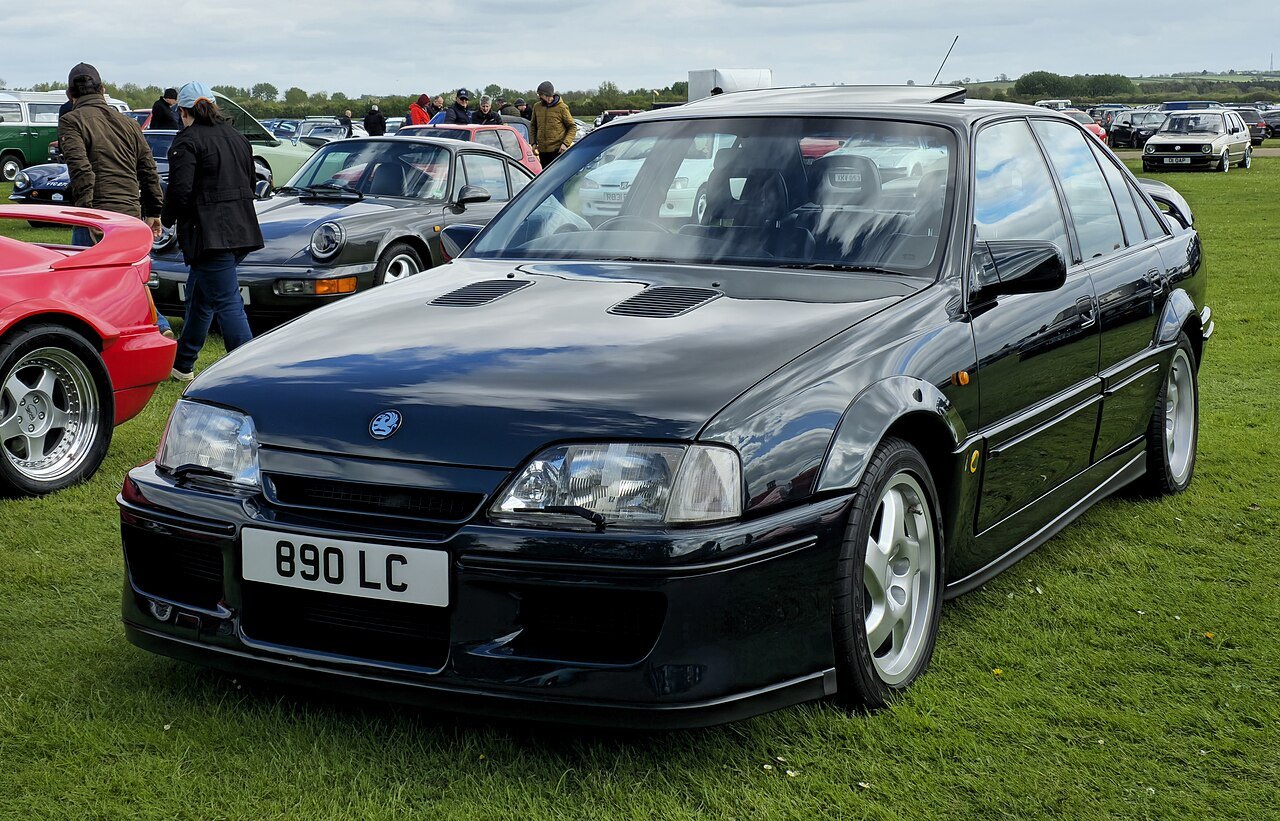
Reducing Vauxhall to a mere photocopy of Opel would nonetheless be unfair, as the brand has had genuine moments of glory. The most spectacular remains the 1990 Lotus Carlton, a large saloon of sober appearance that tuning specialist Lotus turned into a bomb: 377 horsepower, a top speed of 283 km/h, enough to make it one of the fastest saloons in the world at the time. Its speed caused such a stir that it sparked debate even in the British Parliament, with some calling outright for it to be banned. The tabloid press got involved too, fearing it would become the dream getaway car for fleeing robbers, since no police car of the era could catch up with it.
Later on, the brand kept that sporting streak alive with its VXR versions, the British equivalent of Opel's OPC models, and even treated itself to a muscular coupé imported from Australia, the Monaro, inherited from its Holden subsidiary. All of this flew in the face of the staid image usually attached to an entry-level car, and proved that, even when rebadged, a Vauxhall could sometimes have real character.
Today: an English brand within Stellantis
Vauxhall's fate took another turn in 2017, when General Motors sold its European operations, Opel included, to France's PSA for 2.2 billion euros. Four years later, in 2021, the merger of PSA and Fiat Chrysler gave birth to Stellantis, the new owner of the griffin badge. Today's Vauxhalls, the Corsa, Astra, Mokka, Grandland and Frontera, are therefore no longer German Opels but shared Stellantis models, often of French design, still badged as Vauxhalls exclusively for the United Kingdom.
The brand is nonetheless going through a pivotal period. Its historic Luton plant, opened in 1905, closed its doors in 2025. It had, however, stopped assembling passenger cars back in 2002 and had specialised in vans, since it's often forgotten on the continent that Vauxhall is also a heavyweight of the commercial vehicle market in Britain, with its Vivaro and Combo models. The Ellesmere Port site has now taken over, converted to building electric compact vans. Like the rest of the group, Vauxhall is shifting toward electric power, but its model remains unchanged: selling, on a single island, cars that the rest of Europe knows under another name.
One real question remains: why persist in keeping a badge that, mechanically, covers no car of its own? The answer probably lies in whatever is least rational about the automobile. For a Briton, that little red griffin evokes their father's car or the family's first car, a piece of national industrial history more than a century and a half old. As long as that emotional bond holds, the brand will go on living its strange existence: very old, very English, and yet never quite entirely itself.
Want to explore this curiosity further? Find Vauxhall brochures to download for free on Brochure Auto.
Gallery
Photos © DieselFordMondeo, Calreyn88 et Vauxford / Wikimedia Commons (CC BY-SA 4.0)
- https://en.wikipedia.org/wiki/Vauxhall_Motors
- https://fr.wikipedia.org/wiki/Opel