Peugeot E-208 GTi: the GTi legend goes electric, with 281 horsepower under your right foot
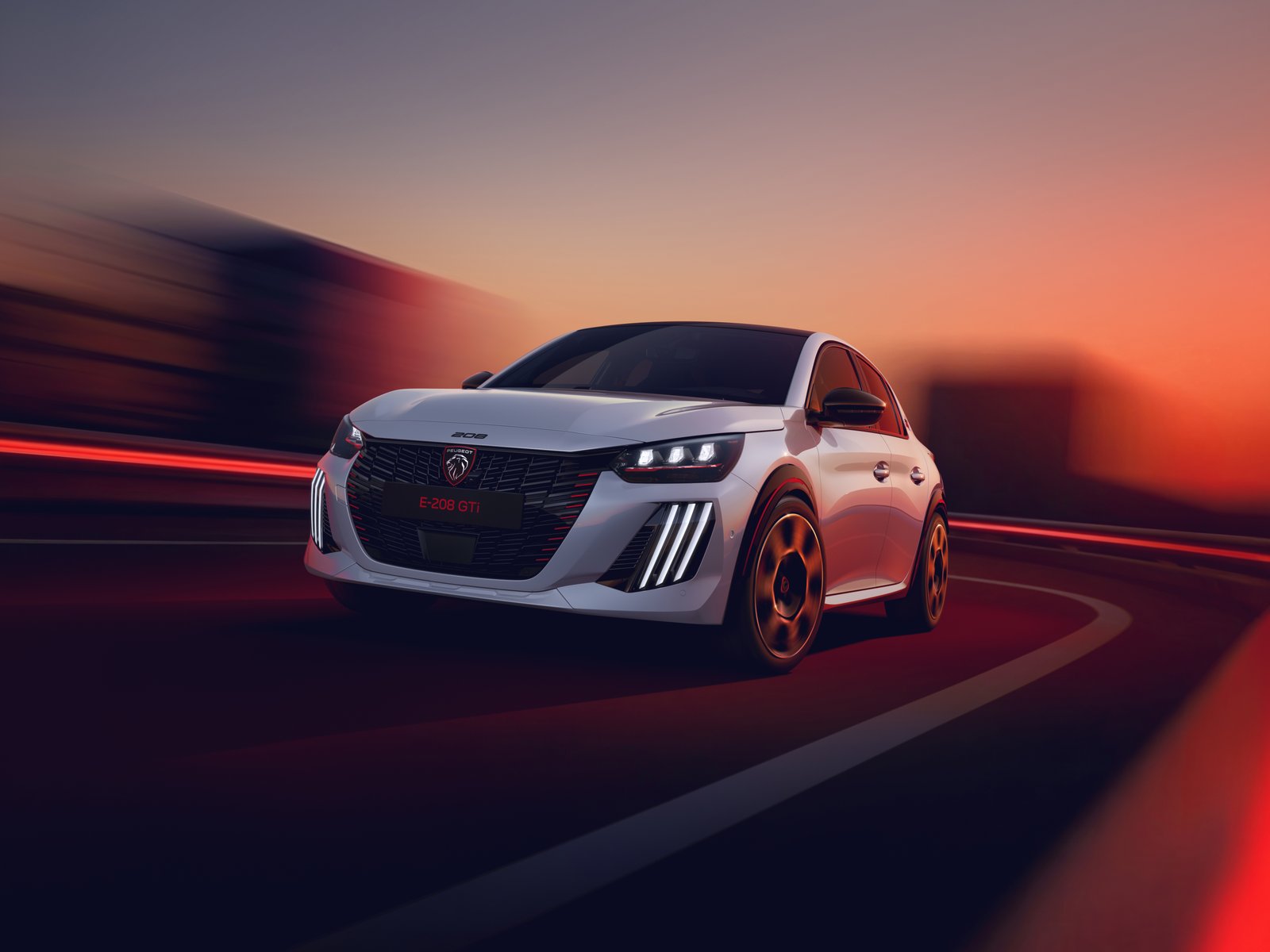
At Peugeot, three letters carry more weight than all the others. Since the last 308 GTi rolled off the Sochaux production line on 2 December 2020, no production car from the Lion brand has worn the GTi badge, as if the manufacturer was simply waiting for the right moment to pull it back out of the drawer. That moment now has a name, the E-208 GTi, and it comes with a bold stance that won't leave anyone indifferent: it's 100% electric. Presented in its final version this spring, it will make its big public debut in France at the Paris Motor Show, from 12 to 18 October. A perfect opportunity to take a close look at this heir to a name that made several generations dream.
A badge that isn't handed out lightly
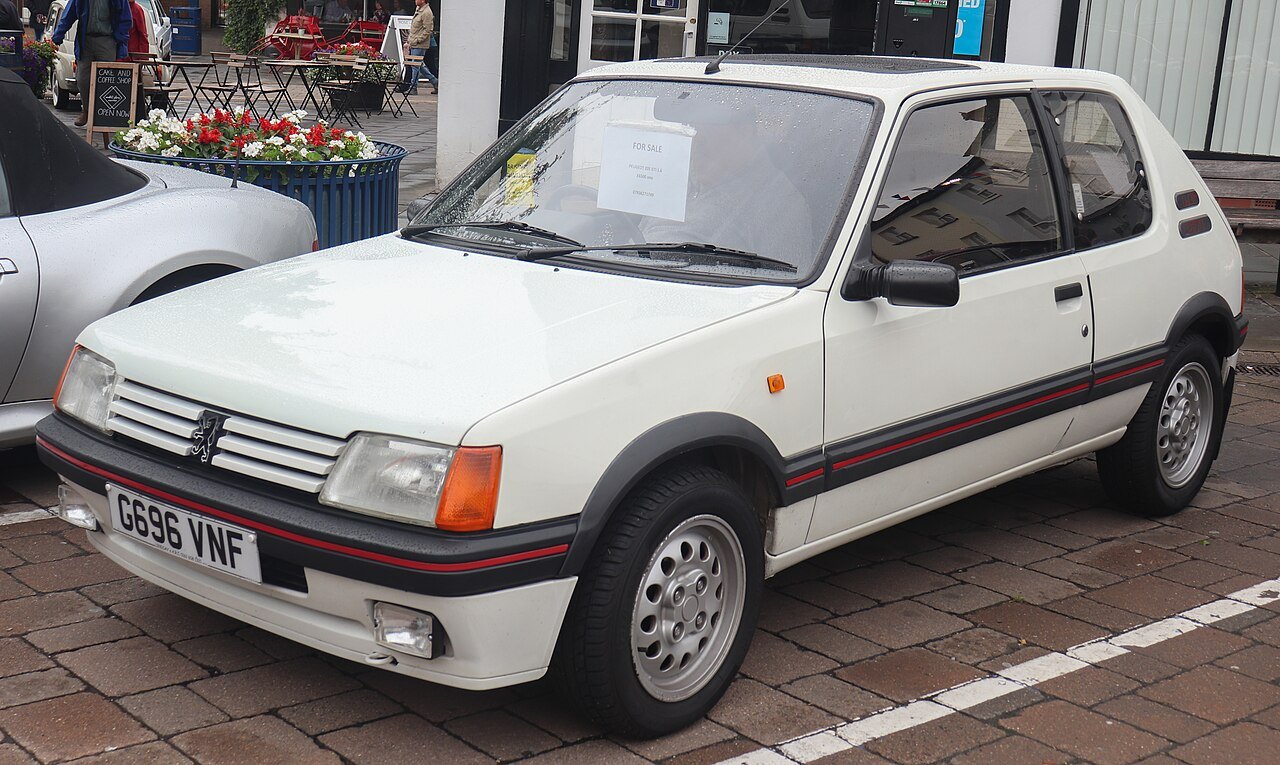
To understand what these three letters represent, we need to go back to 1984 and the 205 GTI, first in 1.6-litre form, then in 1.9-litre guise from 1986 onwards. Light and playful, it turned the affordable hot hatch into an object of desire and firmly embedded the badge in enthusiasts' minds for good. Its successors then carried the torch, from the 306 to the 206, then the 207, the first 208, and finally the 308 GTi, with varying degrees of success depending on the era.
After the 308 GTi was discontinued at the end of 2020, Peugeot let the badge rest, favouring for a while the PSE label for its electrified sporty models rather than slapping these three letters on just any vaguely sporty trim level. The manufacturer says so itself: GTi is not just a sticker, it's a distinction reserved for models that truly deserve the name. By choosing to revive it on an electric car, the brand is making a bet that is as bold as it is risky, facing purists who still associate the GTi badge with the roar of a four-cylinder engine revving hard.
From Le Mans to Le Mans, from concept to production
The comeback happened in two stages, always at the same location. On 13 June 2025, on the eve of the 24 Hours of Le Mans, Peugeot unveiled a first E-208 GTi announced with 280 horsepower and a 0-100 km/h time of 5.7 seconds. A year later, in June 2026, the brand returned to the Sarthe circuit to present the production version, very faithful to the car shown the previous year, before detailing its technical specifications and pricing at its press conference on 12 June. In the meantime, engineers fine-tuned the package slightly, with the 0-100 km/h time now dropping to 5.5 seconds.
What's under the skin
Under the bonnet, or rather under the floor, the E-208 GTi relies on the Stellantis group's M4+ electric motor, boosted here to 207 kW, or 281 horsepower, with 345 Nm of torque sent exclusively to the front wheels. Top speed is capped at 180 km/h, a sensible choice to preserve battery life, but it's really the acceleration that impresses, with that 0-100 km/h sprint in 5.5 seconds. With its 281 horsepower, it is simply the most powerful GTi in the brand's history.
To put this power down to the road without the steering wheel tugging at every acceleration, Peugeot has fitted a Torsen-type limited-slip differential, the classic tool for any serious sporty front-wheel-drive car. The track width has been widened by 56 millimetres at the front and 28 millimetres at the rear, giving the car a noticeably more planted stance than a standard 208. There remains one point that will upset nostalgic fans: with its battery, the E-208 GTi tips the scales at 1,610 kilograms, whereas the 205 GTI 1.9 weighed in at under nine hundred. All the engineers' development work has gone into making you forget this extra weight through the corners.
Range and charging: a sports car for everyday use
The battery has a gross capacity of 54 kWh, of which 51 is actually usable. WLTP range varies significantly depending on the tyres fitted: 352 kilometres with the standard Michelin Pilot Sport 4S, designed for grip, and up to 375 kilometres with the more efficient Hankook Ventus S1 evo3. In real-world conditions, and especially when driven enthusiastically, expect considerably less: during its test drive, L'argus saw range drop to around 150 kilometres during spirited driving.
As for charging, the E-208 GTi accepts up to 100 kW on a DC fast charger, allowing it to go from 20 to 80% battery in around 27 minutes, about the time for a coffee at a motorway service station. At home, a 7.4 kW wallbox fully charges it in a little over four and a half hours. Not exactly a long-distance cruiser, but more than capable for daily use, which has always been part of the GTi DNA: practical cars during the week and fun on weekends.
A GTi you'll recognise at first glance
On the outside, the E-208 GTi doesn't play it subtle. The front end features specific bumpers and vertical claw-like light signatures, the GTi logo is displayed on the grille, and the whole car looks wider and more grounded, a direct effect of the widened track. From the side and three-quarter rear angles, the car takes on a stocky stance that recalls, without copying, the compact silhouette of its distant ancestor.
Inside, the atmosphere changes too. The bucket seats, embroidered with the 208 GTi name and trimmed with a red accent stripe, promise far better support than those in the standard version. You'll find Peugeot's signature i-Cockpit layout, with its small steering wheel and digital instrument display set up high, complemented by a large central touchscreen. Red, the GTi's historic colour, appears in small touches throughout the cabin.
€42,900: the price of passion
This is where the debate heats up. Priced from €42,900, the E-208 GTi no longer has much in common with the affordable hot hatch that the 205 GTI once was, and some reviews, such as the one from Caradisiac, openly question this pricing. It must be said that competition is fierce in the emerging segment of sporty electric city cars: the Alpine A290 with its 220 horsepower, the Abarth 600e which goes up to 280 horsepower, and the electric MINI John Cooper Works. Not to mention its own cousin, the Opel Corsa GSE, which shares its 281-horsepower powertrain and is also set to be unveiled at the Motor Show.
Against these rivals, the Peugeot plays the card of pure performance and a name steeped in history. L'argus, which test drove it, praises its "astonishing" grip, an effective Torsen differential, firm and communicative steering, and excellent bucket seats. The magazine, however, criticises the car for being too quiet, with its artificial sound seeming far too deep, an ESP system that can't be fully switched off, suspension damping that feels stiff at low speeds, and a weight that makes it more demanding to drive day-to-day.
Ultimately, the E-208 GTi raises a question that goes well beyond Peugeot: can a sports car still deliver thrills when the engine no longer sings? On paper, the newcomer ticks every box, from its performance figures to the care put into the chassis. It now has to win over drivers on the road and in the hearts of enthusiasts, the very place where the 205 GTI earned its spot for forty years. See you at the Motor Show for a first in-person look.
Want to know more? Find all the Peugeot 208 brochures available for free download on Brochure Auto.
Gallery
Photos © Peugeot
- https://www.media.stellantis.com/em-en/peugeot/press/peugeot-e-208-gti-a-new-legend-is-born
- https://www.media.stellantis.com/em-en/peugeot/press/the-new-peugeot-e-208-gti-more-pleasure-more-gti-than-ever
- https://www.peugeot.fr/nos-vehicules/nouvelle-208-gti/specifications-dimensions.html
- https://www.largus.fr/actualite-automobile/essai-peugeot-e-208-gti-2026-electrique-mais-fantastique-40007991.html
- https://www.caradisiac.com/essai-peugeot-e-208-gti-2026-que-vaut-la-gti-la-plus-puissante-de-l-histoire-224145.htm
- https://en.wikipedia.org/wiki/Peugeot_e-208
- https://fr.motor1.com/news/459014/peugeot-308-gti-fin-usine-sochaux/