Peugeot 205: the sacred number that saved Peugeot and perfected the French GTI
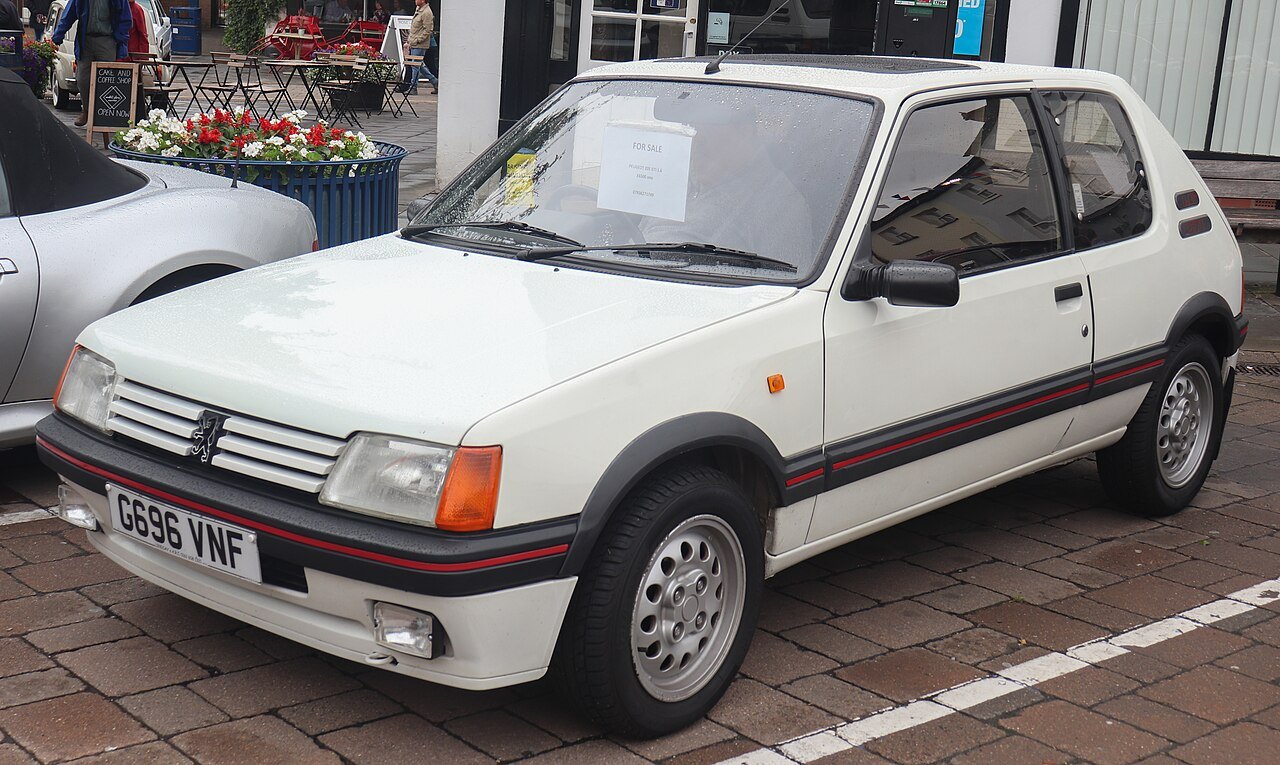
Some cars arrive on the market, and some arrive at exactly the right moment. The Peugeot 205 belongs to the second category, but with a twist: in the early 1980s, the Sochaux-based manufacturer simply couldn't afford to get it wrong. It was unveiled on February 24, 1983. For fifteen years, it would save a company on the brink of collapse and lift the small French sports hatchback to a peak that no one has forgotten. It even added some of the finest titles in world motorsport along the way. Five million two hundred and seventy-eight thousand three hundred units later, it remains one of the most beloved cars France has ever produced.
A last-chance gamble
To understand what the 205 represented, you need to remember the state Peugeot was in at the end of the 1970s. By buying up Chrysler's European operations, namely Simca and Talbot, the group had thought it was expanding, but mainly ended up with colossal debt and overlapping model ranges. The company was losing money, and the project for a new small car, codenamed M24 and in development from 1977, became its last throw of the dice. If this car failed to win over the public, the whole of Peugeot could go under.
The design was handed to in-house teams, with Gérard Godfroy drawing up the first sketches and Gérard Welter, future head of the house style, finalizing the prototype's lines in 1981, while Paul Bracq took charge of the interior. The result hit the mark on the first try, a rare thing in the car industry. The 205 boasted clean proportions, an elegant rear pillar, and a cheerful front end without ever looking twee. The press wasn't fooled, with British magazine CAR going so far as to crown it "car of the decade." Peugeot had bet big, and the gamble was paying off.
A silhouette that won everyone over instantly
The secret of the 205 lay, above all, in pleasing everyone at once. Available in three- and five-door versions, with an engine lineup ranging from modest petrol units to the first 1.8-litre, 60-horsepower diesel launched in September 1983, it could blend into the background as a do-it-all runabout just as easily as it could turn heads in a sportier guise. Its size landed perfectly in tune with the times, compact enough for the city, roomy enough for a family, and its price remained reasonable. Peugeot backed it with a now-famous advertising campaign, the "sacré numéro" ("quite a character"), which cemented the car in the collective imagination as a joyful no-brainer.
Over the years, the range was enriched with special editions that each became a nostalgic touchstone: the Lacoste early on, then above all the Roland Garros, a chic green-and-white version born from a partnership with the tennis tournament, which proved so successful that the name lived on well after the 205 itself. This ability to reinvent itself without ever betraying its identity explains why the little Peugeot remained in the catalogue until December 31, 1998, a venerable age for a mass-market car.
The GTI, the one that defined the breed
While the everyman's 205 filled Peugeot's coffers, it was another version that set hearts racing. The 205 didn't invent the hot-hatch genre: the Volkswagen Golf GTI and the Renault 5 Alpine had already blazed the trail back in 1976. But few cars ever took it to such a level of perfection. The GTI badge appeared on March 1, 1984, first on a 1.6-litre, 105-horsepower model, later boosted to 115. December 1986 brought the ultimate version, the 1.9-litre with 130 horsepower, before output dropped to 122 horsepower for the 1993 model year due to the catalytic converter. On paper, these figures look modest today. On the road, it was an entirely different story.
The recipe hinged above all on an obsession with lightness. Tipping the scales at under nine hundred kilos, the GTI 1.9 sprinted from 0 to 100 km/h in just under eight seconds, enough to go toe-to-toe with the Volkswagen Golf GTI, its great rival from across the Rhine. Its sharp, playful handling, mischievous even, rewarded skilled drivers and sometimes caught the careless out, which only added to the legend. Peugeot even took the concept to its logical extreme with the 205 Rallye, a stripped-down 1.3-litre version launched in 1988: manual windows, bare-bones equipment, and white bodywork adorned with a few stickers, aimed squarely at purists and club racers, it still found more than thirty thousand buyers.
This combination of lightness and agility made the 205 GTI the French benchmark for the small sports car, the legendary GTI that would go on to inspire generations of enthusiasts. Its red trim, perforated alloy wheels, and stocky stance made it an object of desire for an entire generation of young drivers. Peugeot even rounded out the lineup with a convertible, offered as the CT with a 1.4-litre engine and later as the CTI fitted with the GTI's mechanicals, its bodywork penned by Pininfarina in 1986, for those who wanted the thrill with the wind in their hair. Even today, a GTI in good condition commands top prices, and enthusiast gatherings remain as popular as ever.
The Turbo 16, the Group B monster
Peugeot wasn't content merely to sell cars; the brand wanted to win, and it gave itself the means to do so right from the 205's launch. Behind the friendly city car lurked a racing beast, the 205 Turbo 16, of which two hundred units were built for the sole purpose of homologating the car in Group B, the ultimate and most insane category in rally history. Beneath bodywork that borrowed almost nothing from the production model, it housed a turbocharged mid-mounted engine producing around two hundred horsepower and four-wheel drive.
Entrusted to Peugeot Talbot Sport, the team led by a certain Jean Todt, the T16 made a thunderous entrance into the World Rally Championship. In 1985, Timo Salonen delivered both the drivers' and manufacturers' titles to the brand. In 1986, Juha Kankkunen repeated the feat. When the governing bodies decided to ban Group B following a 1986 season marred by several fatal accidents, these monsters, which approached five hundred horsepower in their final evolutions, vanished overnight, and Peugeot remained the last champion of that legendary era. Far from parking its cars for good, the team redirected the T16 toward rally-raids and won the Paris-Dakar two years running, with Ari Vatanen in 1987 and then Kankkunen again in 1988. Every victory reflected back onto the production 205, every triumph boosted GTI sales: rarely have motorsport glory and cash register ever aligned so perfectly.
A character everyone still remembers
In the end, the 205 succeeded at everything it set out to do. It pulled Peugeot out of the ditch and back into profit, it established the idea in France that a small car could be genuinely desirable, and it flew the French flag high atop world rallying. Its production figures, more than five million units in fifteen years, made it the best-selling Peugeot in history until the 206 came along to dethrone it. But no successor has ever truly recaptured that particular magic, that blend of down-to-earth common sense and sporting flair.
Forty years after its debut, the 205 is anything but a dusty antique. It still draws crowds at gatherings, keeps climbing in value among collectors, and still lights up the eyes of those who learned to drive behind its wheel. Perhaps that, in the end, is the hallmark of truly great mass-market cars: they stop being mere modes of transport and become shared memories instead. The 205 truly was "quite a character," and it will remain so for a long time to come.
Want to know more? Find all the Peugeot 205 brochures available for free download at Brochure Auto.
Gallery
Photos © Alexander Migl, Johannes Maximilian, Calreyn88 et Lou6977 / Wikimedia Commons (CC BY et CC BY-SA 4.0)
- https://fr.wikipedia.org/wiki/Peugeot_205
- https://lautomobileancienne.com/peugeot-205-gti-1984-1994/
- https://www.largus.fr/actualite-automobile/peugeot-205-turbo-16-rencontre-avec-la-star-francaise-des-rallyes-10496402.html