Suzuki e-Vitara: The King of the Small SUV Goes Electric Without Denying Its DNA
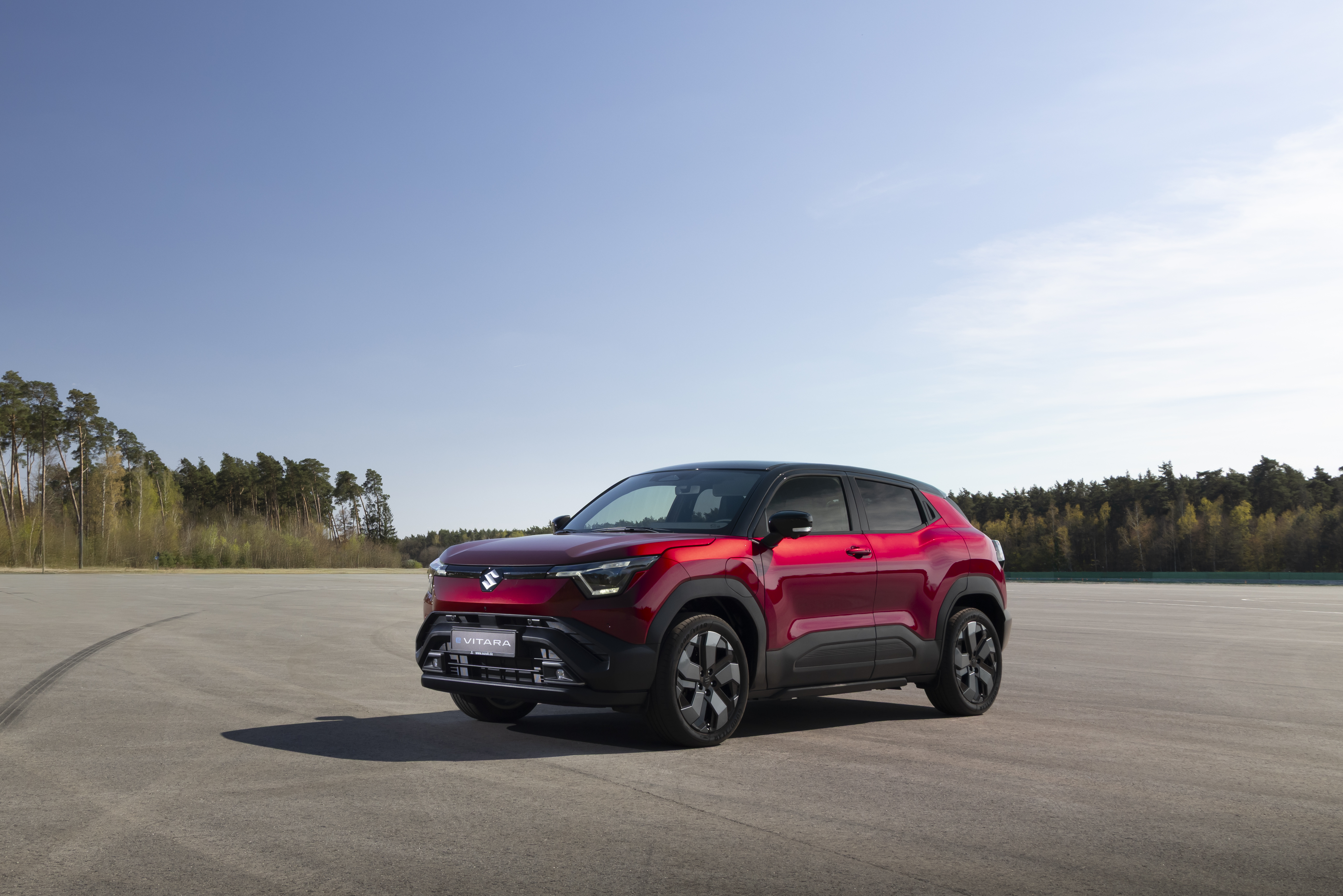
Some brands are diving headfirst into electric vehicles while others are taking their time. Suzuki falls into the second category, and that's no accident: for half a century, the Hamamatsu manufacturer has built its reputation on lightweight, robust and affordable cars — the exact opposite of what the first wave of battery-powered vehicles promised. With the e-Vitara, its first 100% electric model in European history, Suzuki is arriving late to the party. But it arrives with arguments that few competitors can match at this price point.
A name that smells of the open road
The Vitara name was not chosen by chance. It first appeared in 1988 on a small off-roader (sold as the Escudo in Japan) that almost single-handedly invented a category: the compact leisure 4x4, nimble enough for city driving, sturdy enough for rough terrain. By that time, Suzuki already had a solid reputation as a go-anywhere vehicle maker, starting with the tiny LJ10 of 1970 and continued by the SJ and the unstoppable Jimny.
Four generations later, the Vitara has evolved into a family crossover, but the DNA remains: decent ground clearance, available all-wheel drive, and above all a formidable price-to-equipment ratio. It's this heritage that the e-Vitara must now translate into electric form — a more delicate exercise than it seems, given how the battery tends to increase weight and cost.
A platform built for the battery
First plus point: Suzuki didn't jury-rig a body around a conventional platform. The e-Vitara is built on a dedicated architecture called HEARTECT-e, a "skateboard" design with the battery mounted flat in the floor. The benefit is classic but real: lowered center of gravity, reduced overhangs, preserved interior space despite compact dimensions.
Second interesting choice: battery chemistry. Suzuki opted for lithium iron phosphate (LFP), a technology with lower energy density than nickel-based cells, but renowned for greater durability over time, better tolerance to repeated charging and lower dependence on rare metals. For a car designed to last and to be driven extensively, the logic checks out.
The numbers that matter
Two capacities are offered. The 49 kWh battery powers a 106 kW motor, or 144 hp. The larger 61 kWh version steps up to 128 kW, or roughly 174 hp, and claims just under 430 km of range in the WLTP mixed cycle. At the top of the range, the AllGrip-e all-wheel drive adds a second motor on the rear axle: 135 kW (184 hp), 300 Nm, and a claimed range of 395 km.
This is precisely where the e-Vitara stands out. Electric compact cars with four-wheel drive remain rare under €40,000, and extremely rare from a manufacturer that knows off-roading as well as this one does. In France, the range starts at €32,500 in Advantage trim (49 kWh, 144 hp), while all-wheel-drive versions are priced at €37,800 and €40,800. Suzuki adds a launch rebate of €4,000, bringing the entry price down to around €28,500.
Early European tests paint the picture of a sensible, easy-to-live-with car, with real-world consumption settling around 20 kWh/100 km off-highway — meaning effective range closer to 250-300 km depending on usage. Nothing exceptional on paper, but a rare overall coherence in this price bracket.
Made in India, sold to the world
The final chapter, and an important one: the e-Vitara rolls off the lines at Suzuki Motor Gujarat in India, where the manufacturer is a historical heavyweight. Roughly half of production is destined for export, to Europe and other global markets. The LFP cells, meanwhile, come from leading Asian suppliers.
This industrial choice says a lot about the company's strategy: rather than chasing record power or range, Suzuki seeks the best balance between cost, usage and durability. A low-key approach, almost contrarian, but perfectly faithful to what the brand has always been — whether in Italy, the Netherlands, Spain or France, where the thermal Vitara still counts many loyal fans.
The e-Vitara therefore doesn't seek to impress: it seeks to convince. And for a first attempt, it's a pretty successful exercise.
Want to compare generations and find detailed specifications for the model? All available Suzuki brochures can be downloaded free of charge on Brochure Auto.
Gallery
© Suzuki
- https://presse.suzuki.fr/section/modeles/e-vitara
- https://www.largus.fr/actualite-automobile/essai-suzuki-evitara-2026-que-vaut-le-premier-vehicule-electrique-de-suzuki-30045998.html
- https://www.automobile-propre.com/voitures/suzuki-e-vitara/
- https://fr.wikipedia.org/wiki/Suzuki_eVitara
- https://en.wikipedia.org/wiki/Suzuki_e_Vitara