"Mini: forty years, five parent companies, and one single legend"
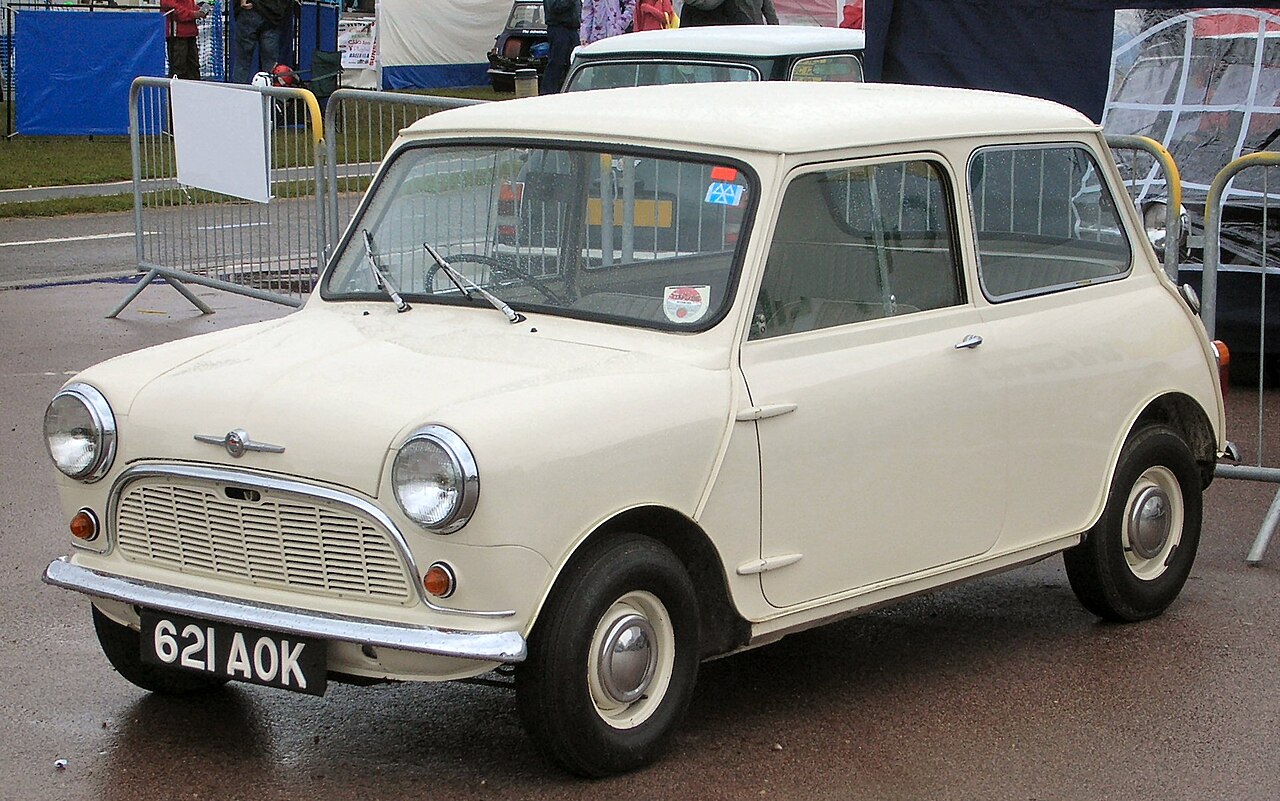
Some cars change their name from one generation to the next. The Mini did the opposite: it kept the same silhouette for forty-one years, but changed owners a good half-dozen times. Austin, Morris, Riley, Wolseley, BMC, British Leyland, Rover, then BMW: open an old British brochure and you'll stumble upon a patchwork of logos that seems to make no sense at all. Rest assured, it does. Here's the story of the smallest of the great cars, and the key to understanding the famous "mess" of British badges.
1959: two cars for the price of one
By the late 1950s, Europe was short on fuel and the automobile had to reinvent itself on a smaller scale. The project was entrusted to a Greek-born engineer of recognized genius, Alec Issigonis. His idea was strikingly simple: mount the engine transversely at the front, slide the gearbox underneath the block, and push the four tiny wheels right out to the corners of the body. The result was a car just three metres long that still offered room for four adults. Front-wheel drive combined with this transverse layout would go on to become the worldwide standard for small cars; almost every city car on sale today descends from it.
Presented to the press in April 1959 and unveiled to the public on 26 August of that same year, the newcomer arrived straight away in two guises. Exactly the same car, but sold under two different names: the Austin Seven on one side, the Morris Mini-Minor on the other. Why on earth duplicate a single model like that? The answer lies in the manufacturer's org chart, and that's where the real puzzle begins.
The "British muddle" finally decoded
The Mini was born at BMC, the British Motor Corporation. This group was itself the product of a merger: in 1952, the country's two biggest carmakers, Austin and Morris, joined forces. But Morris didn't arrive at the altar alone. It brought along a whole portfolio of brands acquired over the decades: MG for sportiness, Riley and Wolseley for prestige. BMC thus found itself in charge of five brands at once, each of which continued to exist with its own dealers and loyal customer base.
Rather than run five different ranges side by side, which would have been costly to design, the group adopted a very pragmatic method the British call "badge engineering": design a single car, then dress it up with different grilles and different logos to sell it under each brand. That's why a single range brochure can show MG, Morris and the BMC crest side by side: BMC isn't a car brand, it's the parent company; MG and Morris are two of its brands. The Mini is the perfect example of this system, having been sold simultaneously as an Austin, a Morris, a Riley and a Wolseley.
What followed only thickened the knot. In 1966, BMC absorbed Jaguar and renamed itself British Motor Holdings. Two years later, in 1968, this new entity merged with the Leyland group, owner of Triumph and Rover, to form a giant: British Leyland. Under this single roof were now gathered Austin, Morris, MG, Riley, Wolseley, as well as Jaguar, Triumph, Rover and Land Rover. About a hundred companies in total, which explains quite a few of those logos. So remember the simple rule that applies to any brochure from the era: the brand is whatever is printed on the grille; BMC or British Leyland are merely the groups that explain the family ties.
Riley Elf and Wolseley Hornet: the Mini in its Sunday best
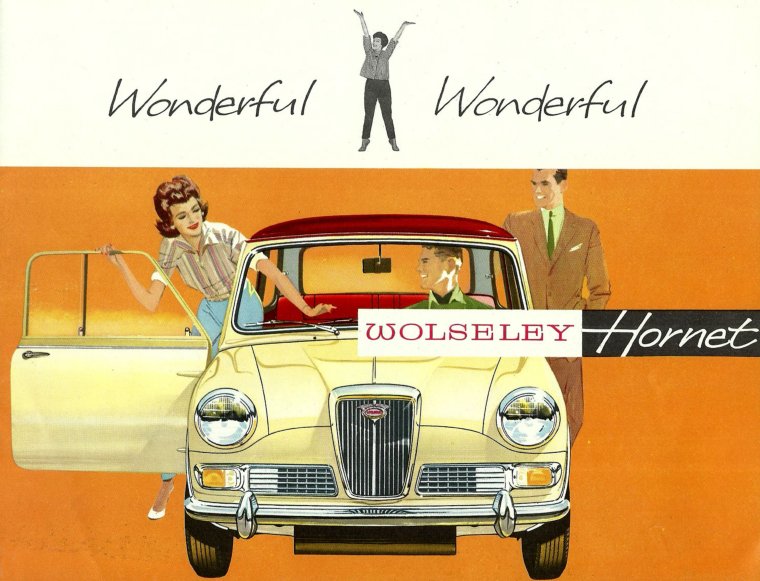
Badge engineering gave the Mini its most unusual variants. As early as 1961, BMC launched the Riley Elf and the Wolseley Hornet: two Minis dressed up as smart little saloons. They were fitted with a traditional upright grille, a lengthened boot that broke up the original two-box silhouette, and a more refined cabin, complete with wood trim and round dials. Mechanically, they were Minis; commercially, they targeted a wealthier clientele willing to pay a little more to drive a car wearing a more prestigious badge. Produced until 1969, they remain the most sought-after Minis among collectors today.
Cooper and Monte-Carlo: the little car that toppled the big ones
The sporting legend, meanwhile, owes everything to one man: John Cooper, tuner and Formula 1 constructor, and a friend of Issigonis. Convinced of the little car's potential, he created the Mini Cooper as early as 1961, followed in 1963 by the formidable Cooper S. On the icy roads of the Monte Carlo Rally, these small cars with hopped-up engines would humiliate machines twice as powerful thanks to their agility and roadholding. The Cooper S won in 1964 with Paddy Hopkirk, again in 1965 with Timo Mäkinen, then in 1967 with Rauno Aaltonen.
The 1966 edition remains the most famous… for the wrong reasons. The Minis crossed the line in the top three places, but the stewards disqualified them over a technicality: their headlights used bulbs that didn't comply with the race's lighting regulations. Victory was then awarded to a Citroën DS, whose driver, embarrassed by the circumstances, even hesitated to step onto the top of the podium. Far from tarnishing the Mini's reputation, this mishap only fuelled its image as the plucky little rebel the establishment couldn't manage to silence.
1969-2000: the Mini finally becomes a brand
It wasn't until 1969 that British Leyland stopped multiplying badges and turned "Mini" into a brand in its own right, placed under its Austin-Morris division. No more Austin Mini or Morris Mini: the car now simply carried its own name. The following decades would prove turbulent for its manufacturer, nationalised in 1975 and reorganised several times over, eventually becoming the Rover Group in 1986. The Mini, for its part, weathered all these upheavals without flinching and ended its career badged as a Rover.
The plucky little British car held on, buoyed by an icon status that few cars ever achieve. The last classic Mini rolled off the line in October 2000, after forty-one years of almost uninterrupted production. The total is staggering: around 5.38 million units according to various sources, making it by far the most-produced British car in history.
2001: BMW and the rebirth
In the meantime, a new player had entered the scene. In 1994, German carmaker BMW bought the Rover Group. Six years later, it reorganised its assets and kept one particular jewel: the Mini name. In 2001, a brand-new car appeared, this time spelled in capital letters, the MINI. Bigger and more modern, it had little left in common technically with its predecessor, but it retained the same mischievous spirit and retro wink. It's this model, regularly updated ever since, that keeps the legend alive today.
The Mini under every badge: the original brochures
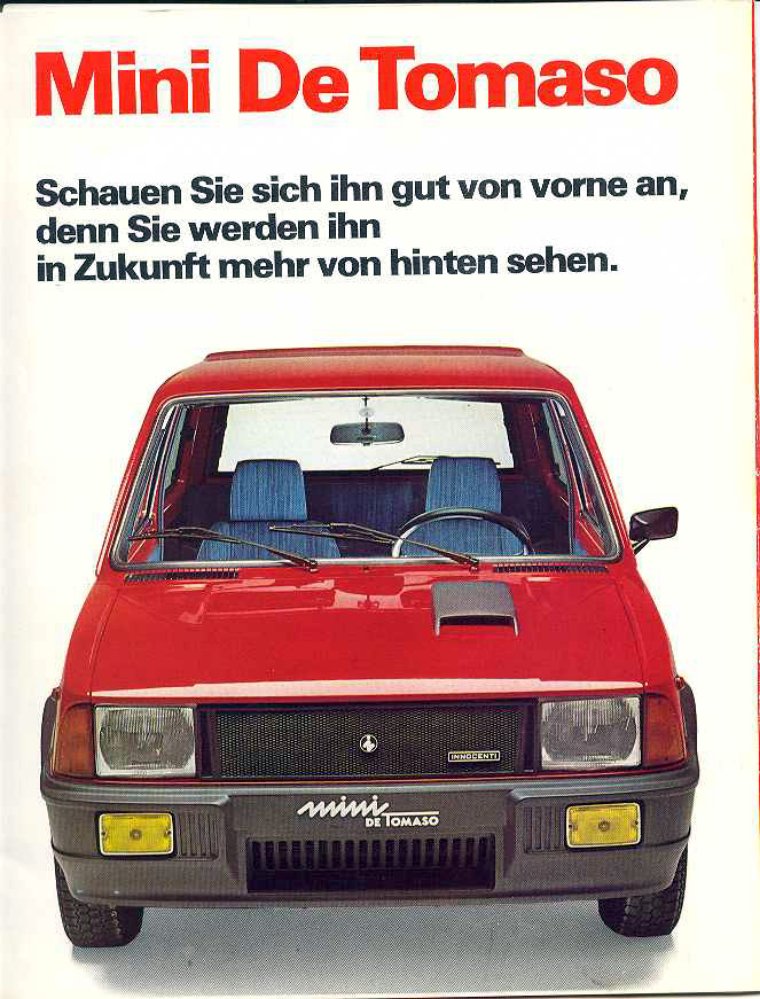
The most telling way to see it is to lay the catalogues side by side. A single piece of mechanical engineering, but a different cover for each brand: at Austin it reads "Cooper", at Morris "Mini-Cooper" or "850", in Denmark "Mascot", in its smart guise "Elf" and "Hornet", in Italy "De Tomaso". Here are a few original leaflets, available to view and download on Brochure Auto.
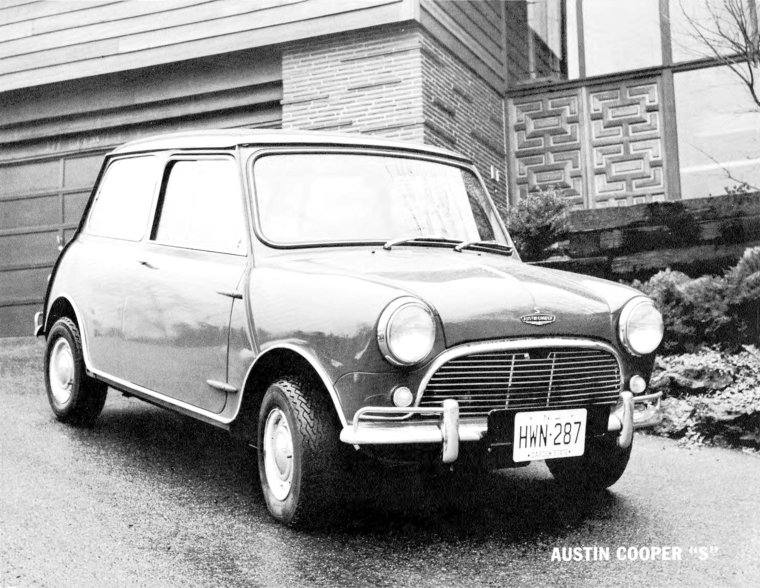
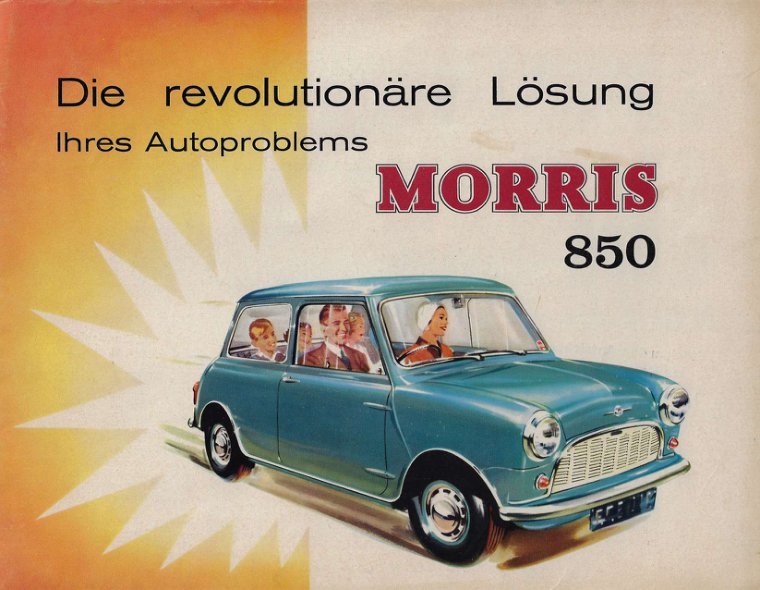
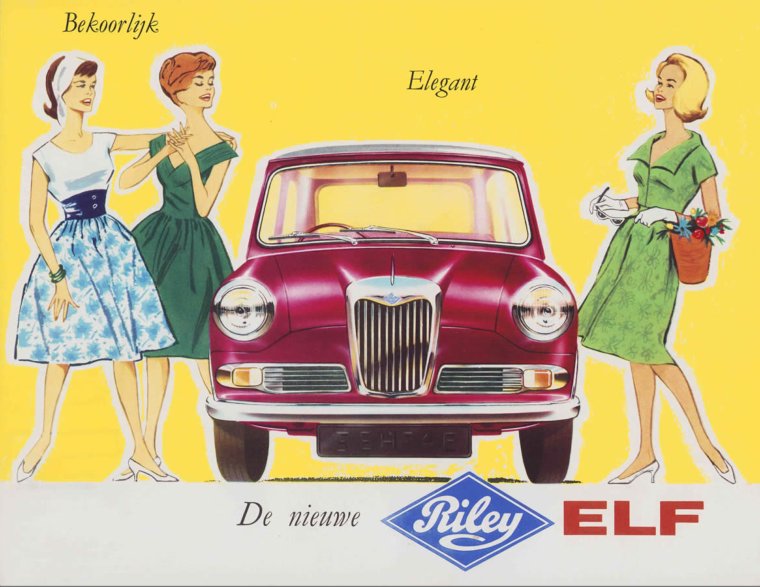
Two cars, then, not to be confused: the classic Mini from 1959 to 2000, heir to Austin and Morris, and the modern MINI from BMW. Between the two lies the same clever compact shape and forty years of eventful industrial history. To carry on the journey, explore the original brochures on Brochure Auto, badge by badge: Austin, Morris, Mini, Riley, Wolseley and Innocenti — plenty to help you measure just how far the most endearing of little British cars has come.
Gallery
Photos © Tony Hisgett (CC BY 2.0), User3204 (CC BY-SA 4.0), Calreyn88 (CC BY 4.0), DieselFordMondeo (CC BY-SA 4.0), DeFacto (CC BY-SA 2.5) / Wikimedia Commons
- https://fr.wikipedia.org/wiki/Mini_(automobile)
- https://en.wikipedia.org/wiki/Mini
- https://fr.wikipedia.org/wiki/British_Motor_Corporation
- https://fr.wikipedia.org/wiki/British_Leyland