The Citroën 2CV in brochures: 42 years of a life in glossy paper
Opening a Citroën 2CV brochure is like holding a piece of France in your hands. A fragment of an era printed on paper — sometimes thick and satin-finished, sometimes as modest as the car itself. Over forty-two years of production, from 1948 to 1990, the 2CV generated as many brochures as it did versions: from the almost utilitarian leaflets of the early years to the colorful and inventive catalogs of the 1970s, through to the elegant two-tone documents of the Charleston. Each publication is a small time capsule. And together they form one of the liveliest paper collections in French automotive history.
A car born to be shown — and sold differently
When Pierre-Jules Boulanger launched the Toute Petite Voiture in the 1930s, he wasn't yet thinking about brochures. He was thinking of peasants in clogs, of potholed roads, of eggs that shouldn't break. But when the 2CV A was presented at the Paris Motor Show on October 7, 1948, Citroën had to quickly create its first commercial documents for a car that puzzled everyone — the press first and foremost.
The brochures of the early days reflect the era: sober, almost austere, with black and white or two-color illustrations. They emphasize practical qualities — economy, robustness, accessibility — and show the car in its uses: countryside, delivery, country doctor. The 2CV is not yet an object of desire; it's a tool. The brochures state this plainly, and that's very much to their credit. Serial production began on July 11, 1949 at the Levallois-Perret factory, with a flat-twin 375 cc air-cooled engine and 9 hp — figures that the first technical sheets displayed without hesitation.
The 1960s-1970s: the Deuche emancipates itself, and so do the brochures
In the 1960s, engine displacement increased to 425 cc and power rose to 18 hp. The range became structured with the AZA and AZAM models. Brochures expanded: color appeared, light staging, a car beginning to appeal to youth. The 2CV ceased to be exclusively rural and became the car of students, artists, and free spirits.
In October 1969, the 2CV 4 and 2CV 6 arrived. The 2CV 6 delivered 29 hp from its 602 cc flat-twin — and the brochures of the time now fully played on modernity: geometric typography, vivid colored backgrounds, full-page photos. The Deuche had become trendy without trying, and its commercial documents finally claimed it.
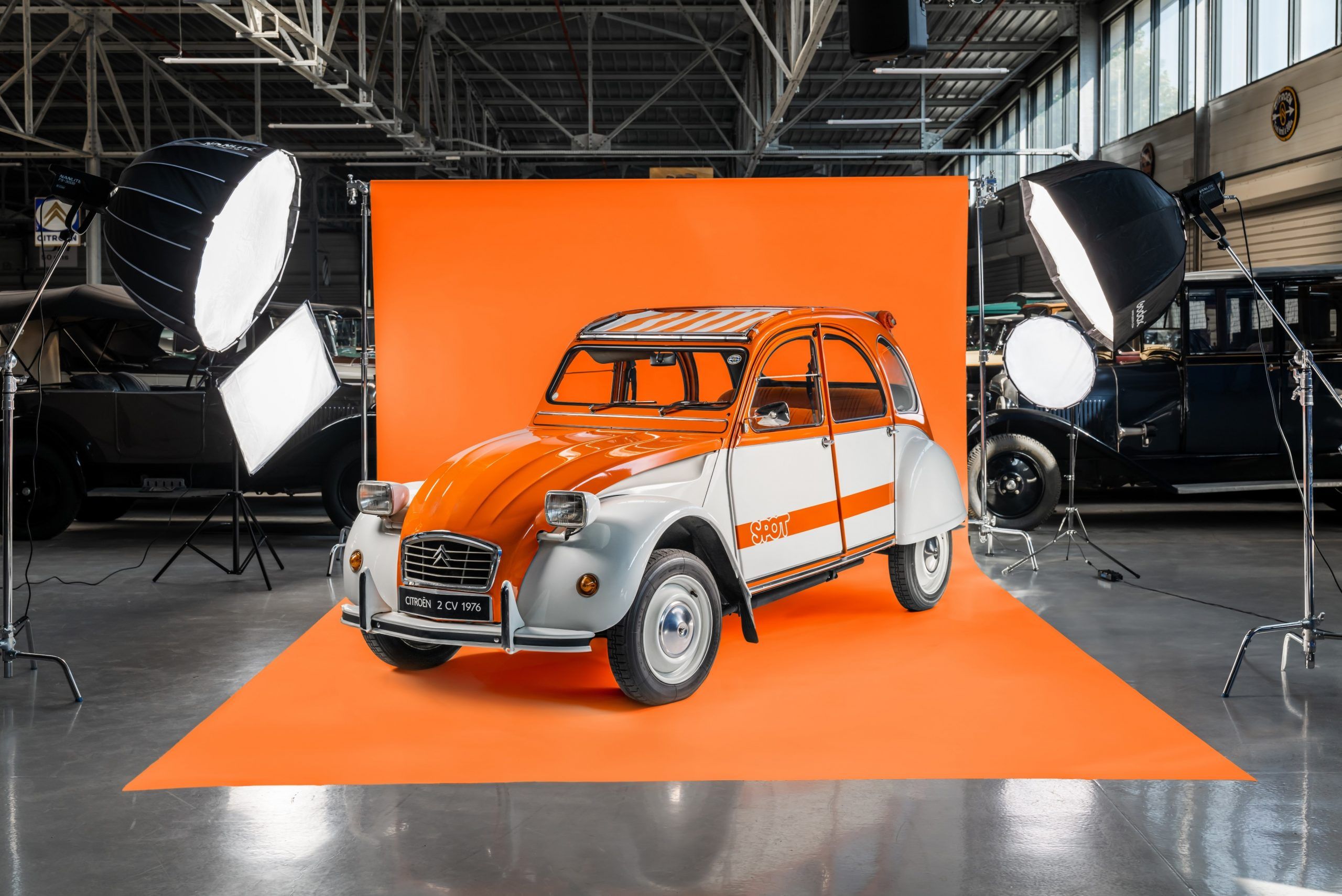
In April 1976, Citroën launched the 2CV Spot, the brand's first limited-edition series: two-tone white and Tangerine orange bodywork, matching upholstery. For the occasion, a dedicated leaflet — printed in the car's colors, naturally — laid the groundwork for a practice that would become systematic: each limited series now had its own document, often printed in small quantities, today as sought-after as the car itself.
Tintin at the wheel — or nearly
This is one of the most delightful chapters in automotive brochure history. In 1988, Citroën launched a major advertising campaign for the 2CV featuring Tintin as the hero. Four brochures, genuine 8-page comic strips in A4 format, were produced with themes familiar to Tintin's universe: treasure hunting, the monster of the snows, the moon… and above all, adventure.
It was Bob de Moor — Hergé's longtime collaborator, who passed away in 1983 — who created these brochures in the pure ligne claire style. Citroën imposed a particular constraint: the 2CV could never be drawn and had to be represented exclusively through photography. The result was nothing short of singular: Tintin, Snowy, Captain Haddock, and Professor Calculus evolved in entirely drawn settings… aboard a photographed car. A graphic UFO that belonged only to the 2CV.
These brochures — including The Adventures of the 2CV and the Haunted Cave and The Adventures of the 2CV and the Abominable Snowman — are today collector's items in their own right, sought after by both 2CV enthusiasts and collectors of the Hergé universe.
The Charleston and the end of a paper era
The Charleston, launched in October 1980 in 8,000 examples in Delage black and red, integrated into the range from 1982 onward, had the most graphically elaborate brochures of the entire model's career. Sophisticated two-tone design, quality paper, retro-inspired layout assumed with confidence. A document you look at like a poster.
On July 27, 1990, the last 2CV rolled off the Portuguese Mangualde factory — a Charleston in Cormorant gray and Nocturne gray, accompanied by a small fanfare. Over 5.1 million units produced, and several dozen distinct brochures across forty-two years, among the French versions, export editions, and limited-series leaflets.
Leaf through the legend on Brochure Auto
The collection of 2CV brochures is the story of a car told by those who had the task — not so simple — of selling it at each era. Even by sending Tintin behind the wheel. Find all the Citroën 2CV brochures available on Brochure Auto, including the Tintin booklets, and explore the entire Citroën catalog to extend the journey.