Panhard: The Forgotten Senior Who Invented the Automobile
Ask around you what is the oldest car brand still written in history, and you'll likely hear Mercedes, Peugeot or Renault. The real answer lies elsewhere, and it has a scent of forgotten France: Panhard. Born in 1887, the Parisian house did not merely manufacture cars — it invented the way they are built. Then it dominated the first races, imposed an art of lightness that still sets the reference, before discreetly fading away in 1967. The story of a pioneer that deserves far better than oblivion.
1887: at the very origins of the automobile
Originally, Panhard is not a car manufacturer but a company specializing in wood machinery, founded by René Panhard and his partner. Everything changes when Émile Levassor joins the venture and seizes a license for Gottlieb Daimler's gasoline engines in 1887. The company takes the name Panhard et Levassor and assembles its first automobiles in the very early 1890s. We are then in the infancy of the genre: the car is a curiosity for wealthy enthusiasts, a haphazard assembly of mechanics still rough around the edges.
This is where Panhard enters legend. In 1891, Levassor develops what will be called the "Panhard System": the engine at the front, a clutch, a gearbox, then transmission to the rear wheels. This arrangement, obvious today, was far from it at the time — and it will become the reference architecture of the automobile for nearly a century. That alone is significant. When a conventional thermal car still positions its engine at the front, it pays homage, unknowingly, to the genius of a French engineer from 1891.
The first victories in racing history
Panhard does not merely theorize: the brand proves its ideas on the road. In 1895, Émile Levassor sets out on the Paris-Bordeaux-Paris race, covering nearly 1,200 km in a single stretch on the potholed roads of the time. He crosses the finish line first after a near-48-hour dash, alone at the wheel. This is one of the very first great victories in motorsport history, and it bears Panhard's colors.
The brand's name will endure in technical vocabulary: the "Panhard rod", this suspension link that guides an axle laterally, is still used today on countless vehicles. Few manufacturers can claim to have left their name to a universal mechanical component.
The interwar years: the audacity of luxury
In the 1920s and 1930s, Panhard moved upmarket and cultivated refinement. The brand adopted valveless engines (with sliding sleeves, under Knight license), renowned for their smoothness and silence — a prestige argument at a time when mechanics remained rough. Panhard also shone on the racing circuits, setting records that made French industry proud.
The pinnacle of this period bears a name: the Panhard Dynamic, presented in 1936. This Art deco sedan is a festival of boldness: aerodynamic bodywork with faired wings, integrated headlights, and above all an astonishing central driving position, with the driver enthroned in the middle of the front bench. Too eccentric for its time, the Dynamic did not achieve the commercial success it deserved, but it remains one of the most fascinating rolling objects of its era.
Post-war: the genius of lightness
World War II reshuffles the cards for French industry. As part of post-war reorganization, Panhard inherits the niche of small economical cars — a 180-degree turn for the former luxury builder. Far from suffering this shift, the brand will excel at it through an obsession: lightness.
The Dyna X (1948) sets the tone. Designed around the principles of engineer Jean-Albert Grégoire, it marries an aluminum bodywork to a small air-cooled flat-twin engine. The result is a car of remarkable frugality, capable of carrying four people with a handful of horsepower. The Dyna Z (1954) pushes the logic further: aerodynamic profile, spacious cabin for six occupants, featherweight and surprising top speed for its displacement. Panhard demonstrates that with mechanical intelligence, you can do much with little — a lesson of striking modernity in an era of energy sobriety.
This philosophy works wonders in competition. Associated with small Panhard flat-twins, craftsmen like DB (Deutsch and Bonnet) win year after year the Performance Index at the 24 Hours of Le Mans, that ranking which rewards efficiency rather than raw power. On the circuits as on the road, Panhard is the king of efficiency.
The 24, a magnificent swan song
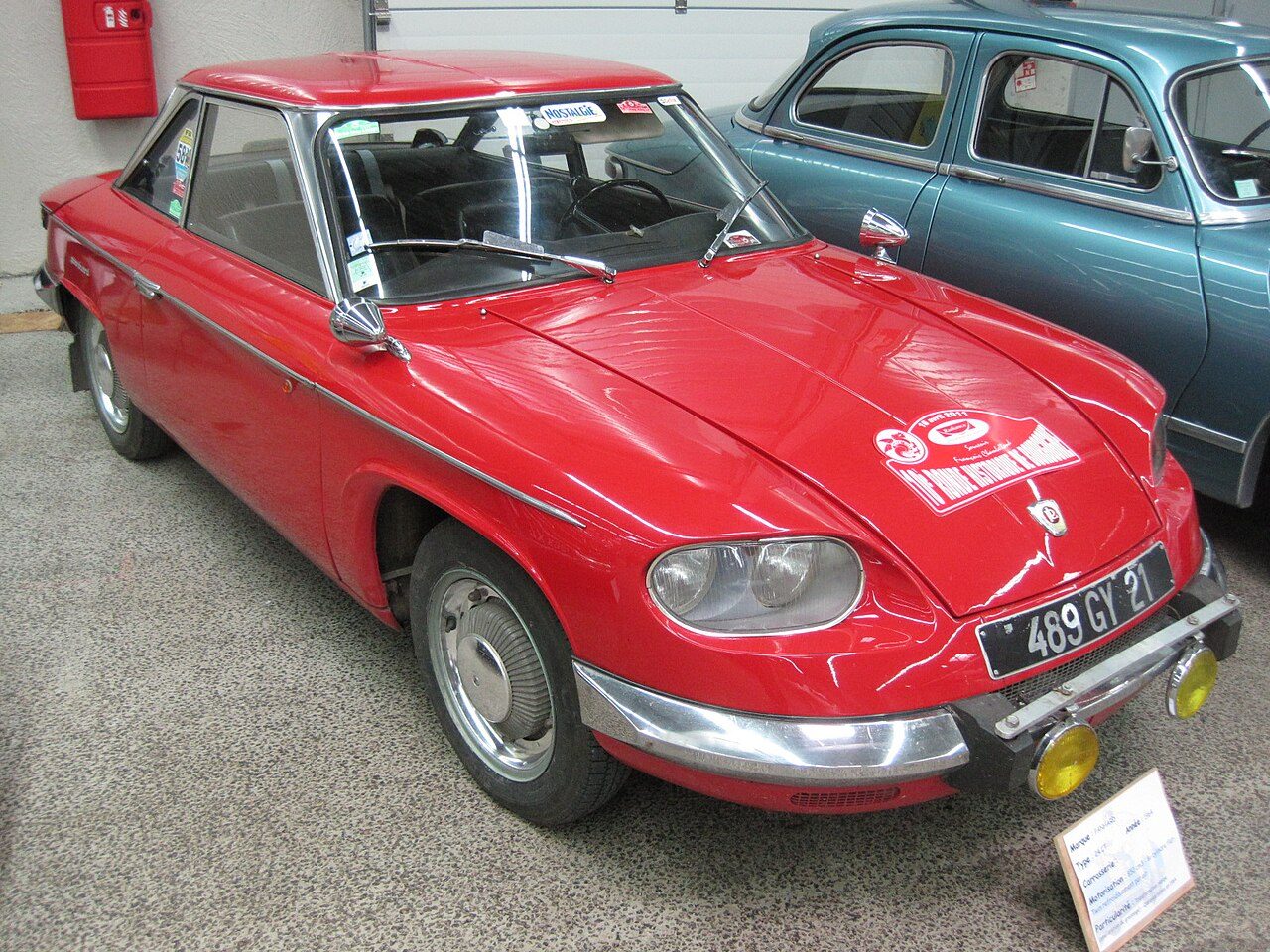
In the late 1950s, the PL 17 took over from the Dyna Z and distinguished itself brilliantly in rallying, even winning the 1961 Monte Carlo Rally. But it is a coupe that will offer Panhard its finest exit: the Panhard 24, launched in 1963. With its low and taut lines, its plexiglass band headlights and its timeless elegance, it remains one of the most beautiful French cars of the decade. Under the hood, still the faithful flat-twin, a guarantee of lightness and low consumption.
The 24 is a total aesthetic success. But it arrives at a moment when Panhard is no longer quite master of its destiny.
Absorption by Citroën — and an unexpected second life
Since 1955, Citroën had been gradually increasing its stake in Panhard, notably using the brand's sales network and factories. In 1965, the double chevron takes full control. Industrial logic is relentless: the two ranges eventually compete, and the small Panhard, despite its qualities, does not weigh much against Citroën's volumes. Panhard's automobile production stops in 1967, the last 24 leaving the lines that summer. A page turns, without fanfare.
But unlike many other disappeared brands, Panhard does not truly fade. Its name perpetuates itself in a completely different field: that of military vehicles, where the brand already excelled (armored cars, light armored vehicles). This defense branch will continue its journey for decades, keeping the Panhard name alive long after the end of consumer cars. The eldest of automobile makers changed its playing field rather than throw in the towel.
A legacy engraved in every car
What remains of Panhard today? Far more than one might think. The front-engine architecture that structured the automobile for a century, the suspension bar that bears its name, a record of pioneering in racing, and above all this idea that performance is born first of lightness and intelligence — a philosophy that manufacturers are rediscovering today in the era of efficiency. Panhard may no longer have a car in its catalog for a long time, but its fingerprint is everywhere, discreet and essential. A good reason not to forget the world's oldest car brand. Find the period brochures of Panhard to consult and download for free on Brochure Auto.
Gallery
Photos Wikimedia Commons — 1900 : allen watkin (CC BY-SA 2.0) · Dynamic 1936 : Detectandpreserve (CC BY-SA 3.0) · Dyna Z : Saruman (domaine public) · 24 CT : Brian Snelson (CC BY 2.0)
- https://fr.wikipedia.org/wiki/Panhard
- https://en.wikipedia.org/wiki/Panhard
- https://en.wikipedia.org/wiki/Panhard_Dyna_Z
- https://en.wikipedia.org/wiki/Panhard_24
- https://en.wikipedia.org/wiki/Panhard_PL_17
- https://fr.wikipedia.org/wiki/Panhard_et_Levassor