Fiat Grande Panda: The Return of a Transalpine Legend
A small car born from a big idea
There are names that belong to more than just a car. The Panda is a state of mind, a lifestyle, almost a national character in Italy. Forty-five years after its birth, it resurfaces in the guise of a muscular, electrified, and decidedly ambitious Grande Panda. A brief look back at the journey of a city car that has sold more than 7.8 million units without ever pretending to be anything else.
It all began in 1976, when Carlo De Benedetti, then president of Fiat, commissioned Giorgetto Giugiaro — the same man who had just designed the Volkswagen Golf — to create a simple, robust, and affordable car. The guiding idea: a Renault 4 with an Italian twist. Giugiaro summed up his philosophy in one sentence: "The Panda is like a pair of jeans: simple, practical, no frills."
On February 29, 1980, Giovanni Agnelli officially presented the Panda to Italian President Sandro Pertini, who was amazed by the space offered by such a small footprint. A few days later, on March 5, she made her debut before the international press at the Geneva Motor Show. Its name? Borrowed from Empanda, the Roman goddess protector of travelers. Its length? Just 3.38 meters, with all flat body panels — including the windshield — and an engine borrowed from the Fiat 127.
Success was immediate: within two months, Fiat recorded over 70,000 orders. By 1981, the Panda finished second in the European Car of the Year rankings, just narrowly behind the Ford Escort Mk III. A roaring start for a car that would span the decades.
Four generations, one DNA
The first generation remained on the road for 23 years, until 2003, with 5,550,938 units produced. An interesting tidbit: the replacement was initially supposed to be called Gingo, but Renault objected due to too much resemblance to its Twingo name. The newcomer therefore takes the name of its ancestor.
This second generation (2003–2011), designed by Bertone, won the 2004 European Car of the Year title. The third generation arrived in September 2011 at the Frankfurt Motor Show and went on sale in March 2012. Developed in-house by the Fiat Centro Stile under the direction of Roberto Giolito, it is still being sold today under the name Panda Classic, with 125,000 sales in Europe in 2023, making it the 25th best-selling car across all categories. Not bad for a model launched under Sarkozy.
But the real surprise is that these two cars now coexist in the lineup. The Panda Classic continues its career while the fourth generation — the Grande Panda — takes the torch with great ambitions.
The Grande Panda: bigger, greener, more connected
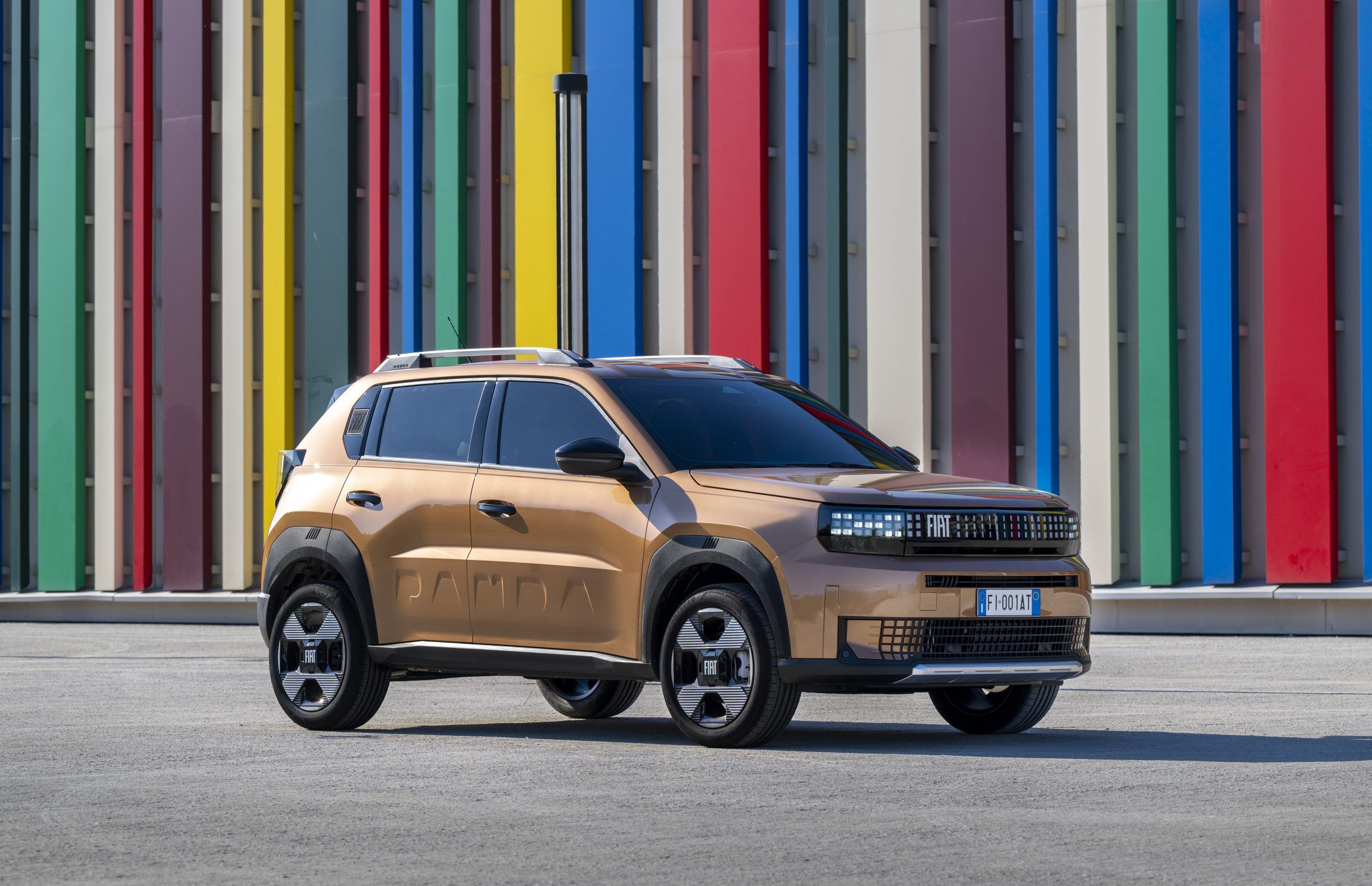
Revealed on July 11, 2024, on the occasion of Fiat's 125th anniversary, the Grande Panda inaugurates a new design language for the brand. And the Italian designers didn't hold back on the nostalgic nods: black plastic wheel arches, "Panda" lettering embossed on the doors, vertical rear lights like the original 1980 model, FIAT logo positioned on the side… Neo-retro is something Fiat has become an expert at.
Technically, the Grande Panda is built on Stellantis' Smart Car platform, shared with the fourth-generation Citroën C3. It measures 3.99 meters, about 30 centimeters longer than the previous Panda, and clearly moves from the A segment to the B segment. It is assembled at the Stellantis plant in Kragujevac, Serbia.
The range is available with two powertrains: a 1.2 PureTech three-cylinder hybrid engine with 100 hp and an e-DCS6 automatic transmission, and a 100% electric version with a 113 hp motor powered by a 44 kWh LFP battery for a claimed range of 320 km according to the WLTP cycle. Pricing starts at €17,900 for the hybrid and €24,900 for the electric version, excluding eco-incentives.
Figures, records, and a mysterious island
Some mind-boggling figures: combining all generations, Panda production exceeds 7.8 million units, of which approximately 4.5 million from the first generation alone.
And then there's Pantelleria. This small Italian island off the coast of Sicily, where more than 80% of cars in circulation are Fiat Pandas — the highest concentration of Pandas in the world. A record as absurd as it is magnificent.
It's also worth noting that the first Panda 4×4 — launched in 1983 with all-wheel drive technology developed by Austrian company Steyr-Puch — had no competitors among European manufacturers at its launch. A small revolution that went largely unnoticed.
The Panda, standing strong
The Grande Panda is not simply a new car: it is Fiat's attempt to reconcile its popular heritage with the demands of modern mobility. The formula is familiar — simple, affordable, functional — but dressed in a body that references without mimicking, and a battery that looks toward tomorrow.
Keen to explore the Grande Panda thoroughly before heading to the dealership? Find the official Fiat Grande Panda brochures as well as those for the Fiat Panda Classic on Brochure Auto. And to learn all about daily driving, the Fiat Grande Panda user manual is also available online.
Gallery
© Fiat