Restyled Mégane E-Tech: the Scénic's face and 500 km of range
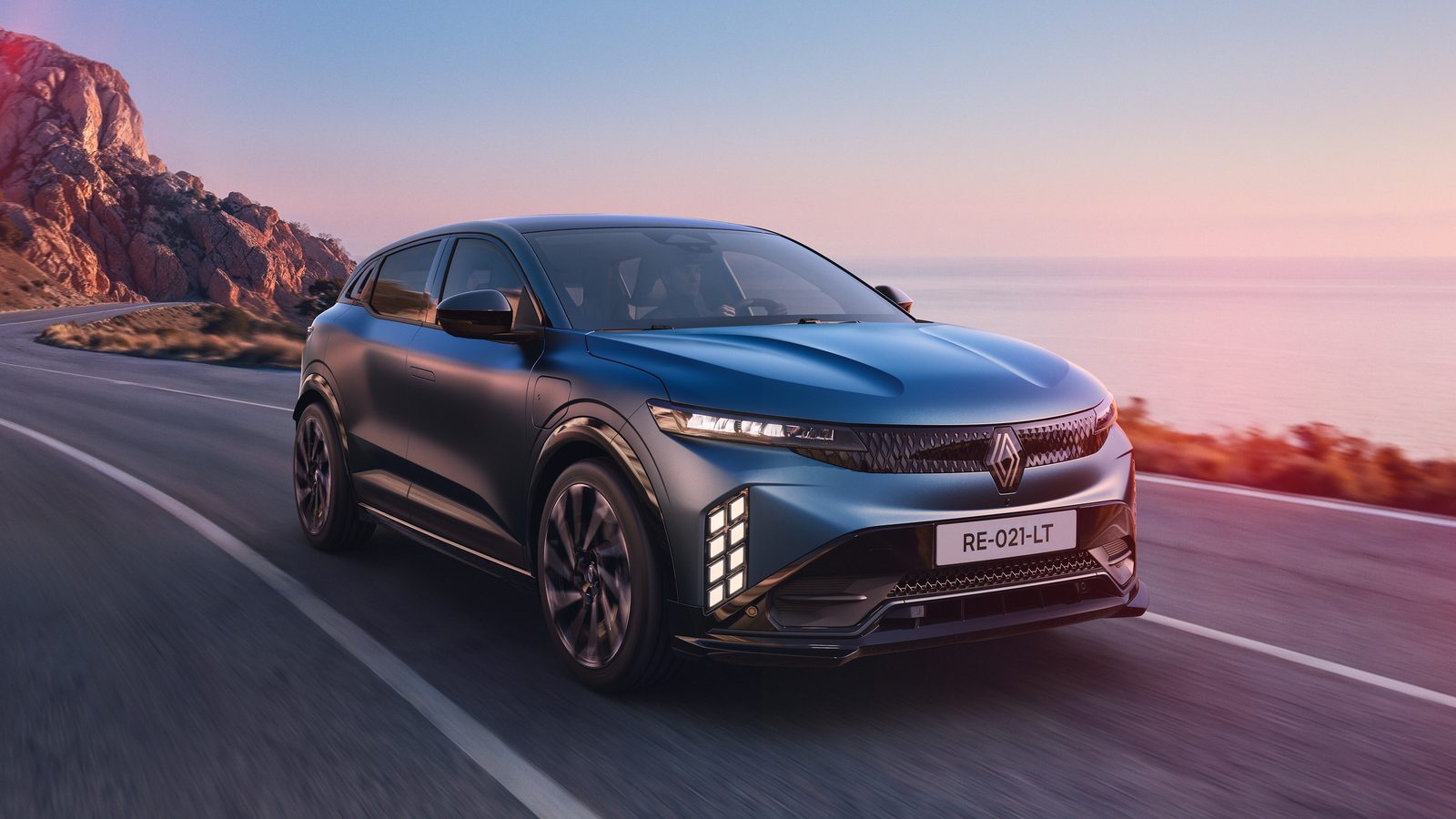
It took four years for the electric Mégane to get a fresh face. Unveiled at the end of 2021 and launched in 2022 as the first Renault built on a platform designed exclusively for battery power, the E-Tech had aged well in substance but not in style: its hook-shaped light signature and "F1" blade were starting to give away its birth year. The facelift unveiled this autumn brings the compact hatchback into line with the rest of the range, battery included.
A family face
The change is obvious from the front. Gone are the hook-shaped daytime running lights linked to the headlights: the Mégane now adopts the diamond-shaped signature already seen on the Scénic, the Symbioz, and the revamped Austral and Espace. The bumper has been resculpted, the ribbed logo now sits proudly at the center of a full grille, and at the rear the lights take on a three-dimensional look. This isn't just a styling exercise: the roofline, narrow-sidewall tires and profiled bumpers have all been reworked to shave off a few tenths of drag, and therefore add a few extra kilometers of range. The cabin, meanwhile, barely changes—and that's by design: the driver-oriented dashboard, with its dual OpenR screen, was already ahead of its time.
LFP battery and 310 miles of range: what's really changing
This is where the real story lies. On an electric car, battery chemistry now matters just as much as power output, and the restyled Mégane changes its recipe. Out goes the original 60 kWh NMC (nickel-manganese-cobalt) battery pack; in comes an all-new 67 kWh LFP (lithium-iron-phosphate) pack, built using cell-to-pack architecture to save space and cut costs. LFP has one known drawback—an energy density roughly 15% lower than NMC—which Renault offsets with a physically larger pack. As a result, the compact hatchback gains two centimeters in height (1.52 m) and about 64 kg on the scale, for a total of 1,772 kg—a detail that won't escape engineers' notice.
It's a trade-off worth making. Range only increases by around 30 km, but it crosses the psychological 500 km threshold on the WLTP cycle, and LFP brings two less visible benefits: better long-term durability, with less sensitivity to repeated full charges, and above all, a flatter charging curve. DC charging power now climbs to 165 kW and, helped by battery preconditioning, holds steady for longer. The result is a 15-80% charge in twenty-four minutes, compared to the longer wait required by the first-generation Mégane. The compact hatchback finally matches the best in its class.
- Battery: 67 kWh LFP (versus 60 kWh NMC previously)
- Range: up to 500 km (WLTP cycle)
- Charging: 165 kW DC fast charging, 15 to 80% in 24 minutes
- Price: starting at around €37,500, or €2,000 less than before
The rest of the mechanical package remains unchanged, and no one will complain about that. The compact electric motor keeps its 220 hp, dispatches the 0-100 km/h sprint in 7.6 seconds, and benefits from a low center of gravity thanks to the battery housed in the floor. The brochure highlights the arrival of "one pedal" driving, now integrated into the regenerative braking system: five levels of energy recovery can be adjusted via the paddles, all the way down to a complete stop without touching the brake pedal. A heat pump and active thermal battery management round out the package, along with bidirectional V2G charging—depending on trim level and market—which can turn the car into an energy reserve for the home or the grid.
Tech, Esprit Alpine and a Google-powered infotainment system
The range narrows around two trim levels now familiar to Renault customers: Techno for the entry point, Esprit Alpine for the sportiest version, complete with a 410-watt Harman Kardon sound system as standard. The OpenR Link system keeps Google built in—Maps with an EV route planner, Google Assistant, and over a hundred apps via Google Play—and the roadmap promises the upcoming arrival of Gemini to boost voice command capabilities. On the safety front, the Mégane stacks up more than thirty driver assistance systems, from adaptive cruise control with lane centering to hands-free parking, plus a "safety coach" that rates driving performance on every trip.
In everyday use, the compact hatchback keeps its practical strengths: 440 liters of boot space, a double floor for cables, a flat floor thanks to the absence of a transmission tunnel, and 209 mm of rear legroom. The color palette leans toward understated elegance, ranging from glacier white to flame red, with an optional contrasting roof.
The price: the game-changing argument
This may be where Renault surprises the most. While the general trend points upward, the restyled Mégane E-Tech starts at around €37,500 including tax, roughly €2,000 less than the model it replaces. The brand highlights significantly lower prices once incentives are factored in, starting at €29,260 for the Techno trim, depending on applicable government incentives. Unveiled this autumn, the compact hatchback is already open for order, with first deliveries announced for as early as October. Enough to give a fresh voice to a French electric car that, sandwiched between the Renault 5 and the Scénic, needed this update.
Want to know more? Find all the Renault Megane E-Tech brochures available for free download on Brochure Auto.
Gallery
Photos © Renault
- https://www.largus.fr/actualite-automobile/renault-megane-e-tech-restylee-2026-design-habitacle-batterie-recharge-quoi-de-neuf-pour-la-compacte-electrique-2207015.html
- https://www.automobile-propre.com/articles/renault-megane-e-tech-2026-ce-quil-faut-savoir-sur-la-compacte-electrique-restylee-aux-500-km-dautonomie/
- https://www.largus.fr/actualite-automobile/prix-megane-e-tech-restylee-2026-les-tarifs-et-la-gamme-de-la-compacte-electrique-revue-et-corrigee-2214407.html