Opel Manta: The People's Coupe That Became an Icon (and Rally Legend)
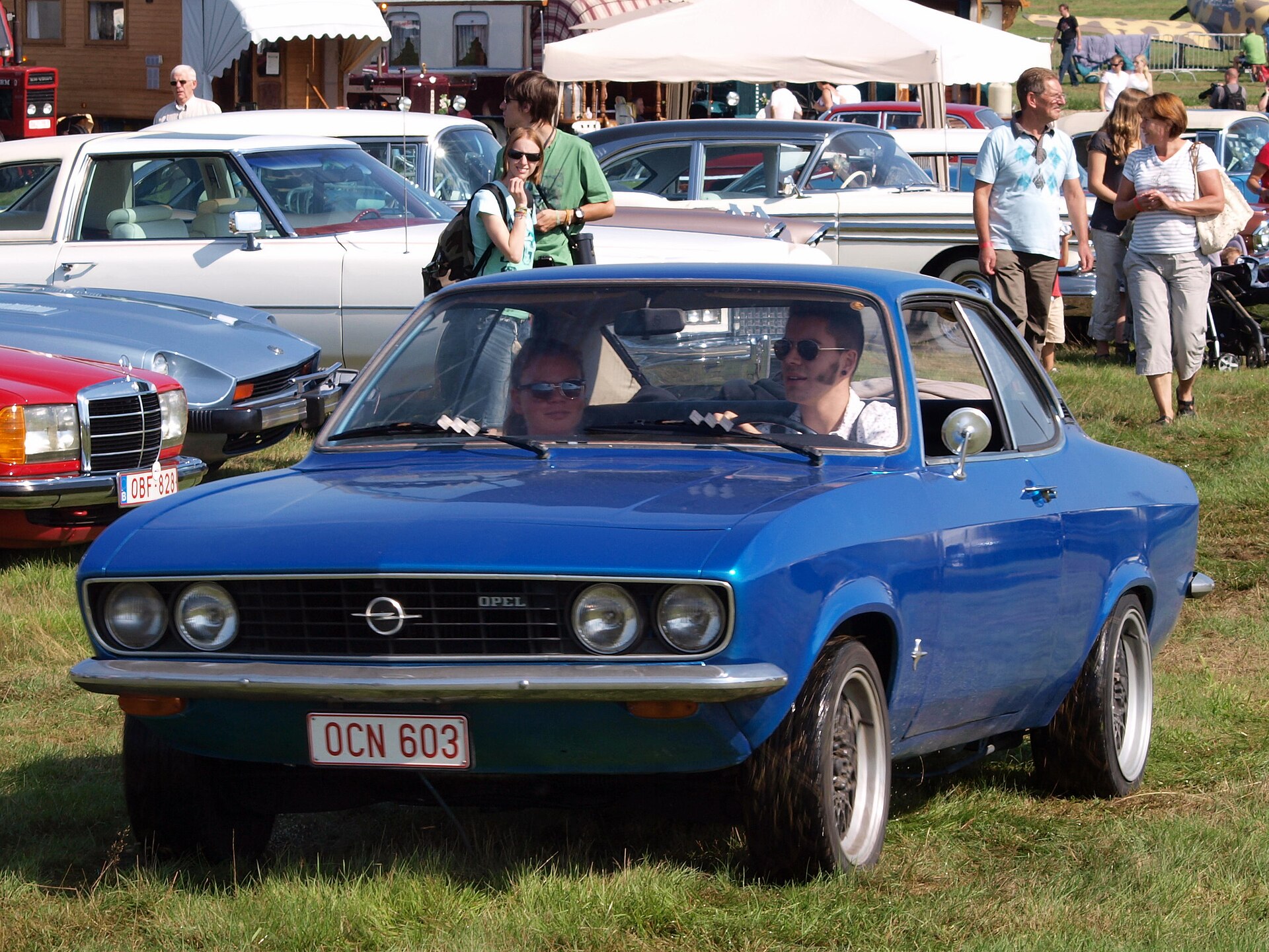
Not all iconic cars are born into luxury. Some start from a simple idea: offering the greatest number of people a touch of style and pleasure without emptying their bank accounts. That's exactly the gamble the Opel Manta took in 1970 — and it's that gamble, kept for eighteen years, that made it one of the most endearing cars of the postwar era in Europe.
A coupe for everyone
The Manta arrived in September 1970, two months before the Ascona sedan with which it shared its technical base. The idea: dress a mass-produced engine in the bodywork of an elegant coupe, at an accessible price. Its obvious rival: the Ford Capri, which played exactly the same game. The battle of popular coupes was on, and it would animate European roads throughout the decade.
The design, created under the guidance of the in-house stylist, hit the mark: long hood, truncated stern, the look of a miniaturized American coupe for Europe, with those four round headlights that would become its signature. Inside, nothing luxurious, but a driver-oriented dashboard and a low driving position that set the tone right away. You don't buy a Manta for rational reasons; you buy it because you want it.
The first generation, the Manta A, bowed out after five years of production and approximately 498,000 units. The Manta B, unveiled in 1975, would do even better: produced until 1988, it became the Opel model that remained in production the longest, for thirteen years, at over 557,000 units. Over the years, the range expanded — up to the GT/E and its two liters of around 110 horsepower, renamed GSi in 1984, or the 2000E with Recaro seats. Nothing extravagant on paper, but a sound, enjoyable, elegant rear-wheel drive coupe with fine chassis credentials, which you could afford on an ordinary salary.
When the sensible Manta puts on its rally suit
Because behind the image of the quiet coupe lies another story, far more muscular. For competition, Opel developed the Manta 400, equipped with a 2.4-liter four-cylinder twin-overhead-cam engine producing 144 horsepower in road trim. And there, the sensible Manta transforms into a formidable rally weapon.
The record speaks for itself. In 1983, Erwin Weber clinched the German Rally Championship behind the wheel of a Manta 400, while in France, that same year, Guy Fréquelin took the national title. The following year, on the stages of the 1984 Paris-Dakar, the crew of Guy Colsoul and Alain Lopes won the two-wheel-drive category and finished in an improbable fourth place overall — a series production coupe, or nearly so, in the desert, ahead of far more sophisticated machines. Enough to forge a legend.
What makes this epic so endearing is the context: in an era of Audi Quattro and other four-wheel-drive beasts, the Manta 400 remained rear-wheel drive, true to its series-production mechanics. It played with its weapons, in a sport caught in a technological escalation — and it still scored points. Its raw growl and widened wheel arches remained etched in the memory of an entire generation of spectators.
Far more than a car: a cultural phenomenon
There's one last chapter, and it might be the most delightful. In Germany, the Manta became a genuine cultural phenomenon. Favorite car of a certain passionate, tinkering public, it inspired an entire folklore — the famous "Manta-Fahrer," the Manta driver, a popular character straddling affection and caricature, even giving rise to a successful film in the early 1990s. Few cars can boast of having shaped popular culture as much as the mechanics themselves.
This iconic status never wavered. In 2021, Opel even resurrected the name with the Manta GSe ElektroMOD, an electric restomod reprising the silhouette of the original Manta A, grille transformed into a screen — an elegant way of linking yesterday's legend to today's electric ambitions. Proof, if any were needed, that certain shapes don't age.
Today, a Manta in good condition sells for prices that would make its first owners smile. The people's coupe has become a collector's item — the finest revenge for a car that only ever sought to make pleasure accessible.
Want to extend the ride? Explore the original brochures and catalogs of the Opel Manta — from the 1972 Manta A to the 1980s GSi — available for free download on Brochure Auto.
Gallery
Photos © Calreyn88, Handelsgeselschaft, Collard, Alexander Migl / Wikimedia Commons (CC0, CC BY-SA 4.0)
- https://en.wikipedia.org/wiki/Opel_Manta
- https://lautomobileancienne.com/opel-manta-b-1975-1988/
- https://www.media.stellantis.com/fr-fr/opel/press/50-ans-de-legendes-les-opel-ascona-b-et-manta-b-des-icones-intemporelles-qui-continuent-d-inspirer