Matra-Simca Rancho: The Brilliant Tinkerer Who Invented the French SUV
From utility pickup to adventure dreams
The story begins in 1975, when Philippe Guédon, technical director of Matra Automobile, faces a budget constraint imposed by Jean-Luc Lagardère himself: there's no question of squandering millions on a new model. Matra must work with what it has on hand. Guédon, who knows the ins and outs of the Simca 1100 from having worked on it in the 1960s, identifies the ideal foundation: the VF2, a pickup version of the Simca 1100 utility van. A modern chassis with front-wheel drive, independent four-wheel suspension, and above all a rear end perfectly available to be reconfigured.
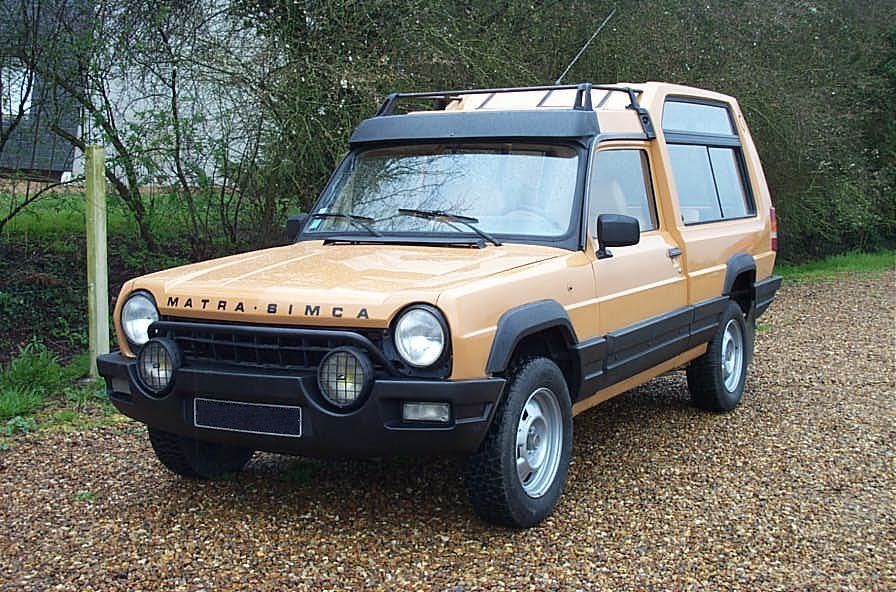
The project receives the internal code P12. Designer Antoine Volanis imagines a raised rear superstructure, generously glazed, mounted on a steel frame and clad in a polyester composite body — a technique already mastered by Matra from its racing cars. Under the hood, it's the "Poissy engine" of 1,442 cc inherited from the Simca 1308 GT that is chosen, for the value of its torque: 80 horsepower, four-speed manual gearbox. All developed for approximately 15 million francs, a record of absolute economy.
Guédon himself would sum up the recipe with a phrase that became famous: "It's French toast applied to the automobile." In other words: you take what's lying around, and you make something delicious out of it.
One name, two badges, a long career
The Matra-Simca Rancho is presented at the Geneva Motor Show in March 1977. Enthusiastic public reception, skepticism from forecasters — who struggle to compare it to anything existing. This disconnect with the standards of the time would be precisely the model's strength.
At launch, the range is simple: a basic five-seater version, with only two side doors (a direct legacy of the VF2 utility body), plus a two-section tailgate. Ground clearance is increased, black plastic bumpers and side protection underscore the rugged look, and 14-inch wheels shod with specific Pirelli all-terrain tires complete the silhouette. All without all-wheel drive: the transverse engine made it technically impossible, and the budget would never have allowed it anyway.
In July 1979, following PSA's acquisition of Chrysler's European subsidiaries in 1978, the Rancho changes badge: it becomes the Talbot-Matra Rancho for the 1980 model year. The name change is accompanied by a welcome expansion of the range. Then appear the X version (superior finish, velvet seats), the AS version (two-seater utility, French market only), and especially the Grand Raid — a version that fired imaginations with its two additional headlights on either side of the windshield, its winch and its limited-slip differential. A clever response to the lack of four-wheel drive, for those who still wanted to venture off the beaten path.
Limited editions with distinctive positioning are added: the Davos (1980, white with blue-red trim and ski rack), the Loisirs (1980, white with blue monograms), and in October 1981, the striking Midnight — black, with red trim, alloy star wheels, chrome accents and complete stereo system. The king of the night, so to speak. A brief convertible Découvrable version, with canvas rear (nicknamed Brezza in Italy), is also offered briefly from 1981, before disappearing as early as 1982 due to rigidity and soft-top problems.
56,457 examples and a huge legacy
Production stops in 1983, with final sales in 1984. The results are spectacular: 56,457 Ranchos left the Matra factory in Romorantin — assembled from bodies supplied by Heuliez and mechanical components from Poissy — more than double the initial 25,000 units planned. A promising niche, which became a relative mass-market success.
The Rancho even appears on the big screen, driven by Claude Brasseur in La Boum (1980) and its sequel, alongside a certain Sophie Marceau. It perfectly embodies the spirit of the decade: accessible adventure, laid-back modernity.
But its legacy goes beyond the box office. It's the Rancho that prompted Matra to think about the minivan segment — a reflection that, once PSA declined the project, led Renault to the Espace in 1984. Without the Rancho, no Espace. French toast had quite a taste for quite some time.
Rancho brochures on Brochure Auto
The Matra-Simca and then Talbot-Matra Rancho was the subject of carefully crafted sales brochures, witnesses to an era when automotive marketing bet on escape and the promise of adventure. You can view and download the Rancho brochures available on Brochure Auto, or browse all the Talbot brochures preserved on the site.