Saab 900: the sedan designed by aircraft builders
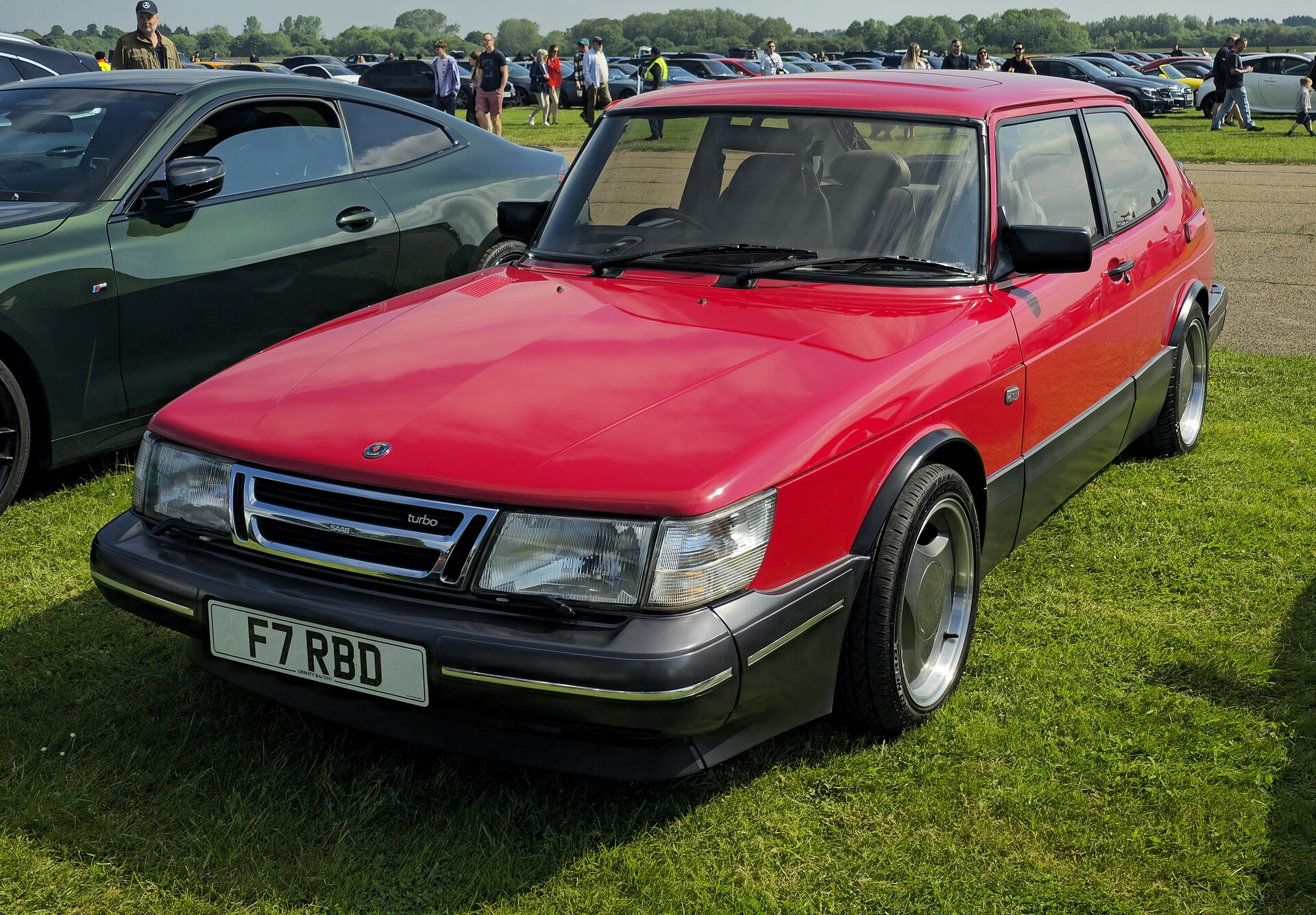
Open the door of a Saab 900 and look for the ignition key. It's not on the steering column: it's placed on the floor, between the two front seats. This detail, which has thrown off generations of test drivers, sums up the Swedish brand quite well. At Saab, they didn't do things differently just to stand out — they did things differently because the engineers, coming from a completely different world, simply didn't have the same instincts.
When an aircraft manufacturer turns to automobiles
Svenska Aeroplan Aktiebolaget was born in April 1937 to build military aircraft. After the war ended, the order book emptied, and something had to be found to do with the factories and engineers. In June 1945, a budget was released for an automotive project entrusted to a tiny team: about fifteen people, led by engineer Gunnar Ljungström and designer Sixten Sason.
None of them came from the automotive industry. The result was immediately apparent: the 1947 prototype, which remained famous under the nickname "Ursaab," displayed a body shaped like a wing. The production Saab 92, commercialized in December 1949, claimed a drag coefficient of 0.30 — an absolute record at the time, in an era when the vast majority of sedans still stacked right angles. The body was stamped from a single piece by a giant press. It was 1949, and Saab was already thinking like an aerodynamicist.
1978: the 900 takes the stage
Presented on May 12, 1978, the 900 derives from the 99 but extends the front overhang to gain in habitability and safety. It retained the company's distinctive architecture, singular down to the last detail: inclined longitudinal engine, gearbox housed under the block, front-wheel drive. And above all, that sharply curved, enveloping windshield, which directly recalled the canopy of a cockpit.
The interior followed the same functional logic: seats reputed to be among the best in Europe, heated before anyone else, careful ventilation, controls arranged to be operated while wearing gloves — a direct legacy of Scandinavian winters and aeronautical habits. The goal wasn't to impress the customer at first glance, but to not tire them out after six hours on the road.
The turbo, tamed before the rest
It was under the hood, however, that Saab left its most lasting mark. As early as 1977, the 99 Turbo had introduced turbocharging on an ordinary family sedan, at a time when the turbo remained the exclusive domain of race cars and a few supercars. The 900 inherited this technology and truly democratized it.
The real breakthrough came in the early 1980s with an in-house knock control system, capable of adjusting boost pressure based on fuel type and conditions. Translation for the driver: a turbo that was finally docile, usable on a daily basis, without the brutal response time that made the first generations so tricky. The 900 Turbo 16, which appeared in 1984, became the reference — fast, safe, and discreet.
The numbers behind a quiet success
Success was real. The year 1984 marked the peak with 88,188 units produced, and in total more than 900,000 "classic 900s" would roll off the production lines — by far the brand's biggest commercial success. The convertible, launched in 1986, became a phenomenon in itself and extended the model's career well beyond expectations.
The convertible, incidentally, hid a little-known particularity: it was never assembled in Sweden. Saab entrusted its manufacture to Valmet in Uusikaupunki, Finland, where the first examples rolled out in the spring of 1986 — at only 400 units for the first year. The Finnish factory would then assemble all of the brand's convertibles for nearly twenty years. A Swedish drop-top made in Finland: the entire industrial logic of Northern Europe is contained in that anecdote.
Production of the classic 900 ended on March 26, 1993, with the convertible continuing for a few more months. A second generation succeeded it on a shared technical base, more conventional. Saab Automobile would shut down in 2011, after several changes of ownership; but the brand still maintains today one of the most active enthusiast clubs in Europe, from Sweden to the Netherlands via Germany, Belgium, and France.
The Saab 900 was never the best-selling or fastest in its class. It was simply designed by people who asked different questions — and that's exactly why it's collected today.
Want to learn more? Find all the Saab 900 brochures available for free download on Brochure Auto.
Gallery
Photos © IFCAR, Calreyn88, David Wright, Renée Kools, Bene Riobó / Wikimedia Commons (domaine public, CC BY 2.5, CC BY 4.0, CC BY-SA 4.0)
- https://en.wikipedia.org/wiki/Saab_900
- https://www.saabmuseum.com/900/my.html
- https://www.hagerty.co.uk/articles/buying-guide-saab-900-turbo-1979-1993/
- https://www.carjager.com/en/blog/article/saab-92-mere-de-toutes-les-saab.html
- https://www.moniteurautomobile.be/actu-auto/nostalgie/saab-avions.html
- https://www.saabplanet.com/444-000-saab-900-cars-from-valmet/