Autobianchi: The Little Laboratory Where Fiat Tested Its Wildest Ideas
Big groups often have a shadow brand, the one that takes the risks and irons out the flaws. At Fiat, this role fell for nearly forty years to a small Milanese house whose name means little to the general public today: Autobianchi. Yet behind this discreet badge lies one of the most important technical ideas in modern motoring — and a working method that speaks volumes about the caution of giants.
A pact between three names
Autobianchi was born on 11 January 1955, from the union of three Italian players: the venerable manufacturer Bianchi — one of the oldest Italian houses, founded in 1885 and a master of bicycles then motorcycles before cars —, which contributed its name and its Desio factory; Fiat, which contributed the money and the engineering; and Pirelli, which contributed the tyres. Officially, a separate brand. Unofficially, a full-scale laboratory. Fiat, being cautious, did not want to risk its image on bold concepts: it would first entrust them to Autobianchi, as a way of gauging public reaction before rolling them out more widely.
The first attempt was a commercial masterstroke. The Bianchina, launched in 1957, was nothing more than a Fiat 500 dressed up with taste — but what a makeover. Chrome trim, two-tone paintwork, a folding roof: it proved that charm and a touch of standing could be sold on a very small mechanical base. Three hundred and twenty thousand customers would be won over by 1969.
The Primula, the revolution nobody saw coming
It was in 1964 that the laboratory fully justified its existence. The Autobianchi Primula debuted a layout that seems utterly ordinary today, and that is precisely where its genius lies: transverse engine, gearbox mounted alongside it, front-wheel drive, all housed under a compact hatchback body. Add to that four disc brakes, an absolute rarity in this category. This "everything up front" layout freed up cabin and boot space, and would go on to become the universal blueprint for small and medium-sized cars.
Fiat was watching closely. The Primula served as the test subject: if the public accepted it, the giant could roll out the recipe across its own models. That is exactly what happened, starting with the Fiat 128, then across hundreds of millions of cars worldwide. Nearly all the city cars and compacts we drive today are, technically speaking, descendants of this little-known Italian.
The A112, the icon that swept everything before it
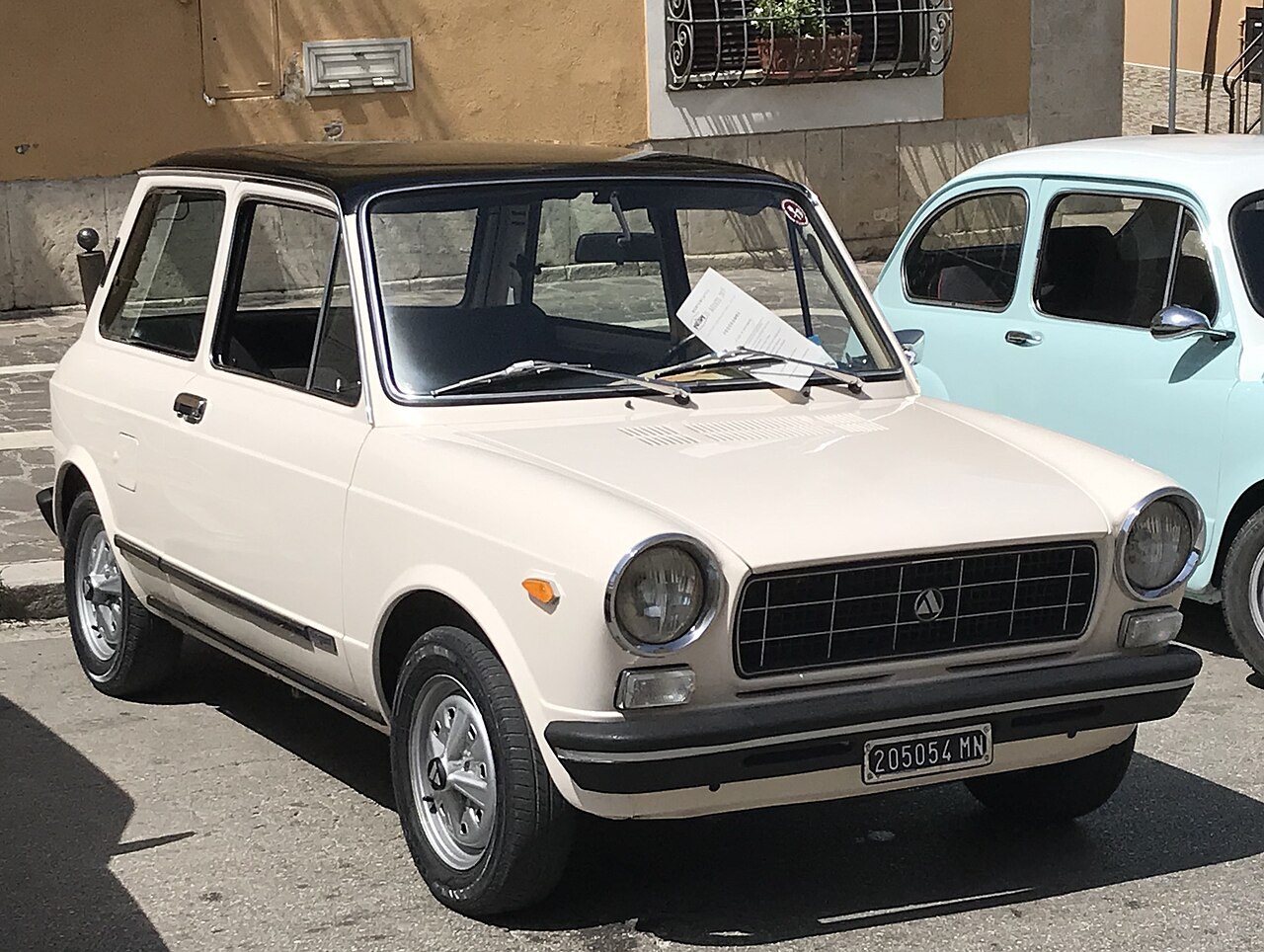
The laboratory also knew how to create stars. In 1969 came the A112, a three-and-a-half-metre pocket rocket that defined the "supermini" concept ahead of its time. Practical, clever and endearing, it would be produced in 1.3 million units and remain in the catalogue until 1986. Its A112 Abarth variant, prepared by the wizard Carlo Abarth — which was, incidentally, his last major work — became a true driving school: generations of Italian rally drivers cut their teeth behind the wheel of this light, lively and playful little bomb. Few small cars have left such an emotional mark on the hearts of enthusiasts.
The final chapter was written in 1985 with the Y10, a mini-premium model recognisable by its tailgate painted black regardless of the body colour. Elegant, well finished, and fitted with the small FIRE engine, it was sold under the Autobianchi badge in Italy and France… before switching to the Lancia label in other markets. That shift was a sign of things to come.
The quiet end of a guinea pig
For the laboratory only had so much time. Absorbed by Fiat as early as 1968, placed under Lancia's stewardship in 1969, the brand gradually lost its autonomy. Once the group no longer needed a guinea pig to test its bold ideas, there was no longer any reason to keep one more name alive: production ceased in 1992, and the Desio factory closed its doors. Autobianchi faded away quietly, almost without anyone noticing.
That is perhaps the finest tribute one could pay it. Its ideas triumphed so completely that they became the norm, and the brand that carried them eventually blended into the background. The next time you open the tailgate of a front-wheel-drive city car, spare a thought for the little Milanese firm: in a way, it is her patent you are closing.
Want to know more? Find all the Autobianchi A112 brochures available for free download on Brochure Auto.
Gallery
Photos © Livioandronico2013, Rahil Rupawala, Handelsgeselschaft, Corvettec6r / Wikimedia Commons (CC BY / CC BY-SA / domaine public)
- https://fr.wikipedia.org/wiki/Autobianchi
- https://en.wikipedia.org/wiki/Autobianchi