Pontiac: 84 Years of American Passion, An Unjust Death
GTO. Firebird. Trans Am. Bonneville. There are names that crack like a cold V8, that smell of burnt rubber and American freedom. Pontiac was all of that at once: a brand that launched the modern muscle car, propelled American automobiles into the era of accessible performance, and graced cinema screens for decades. Yet on October 31, 2010, the last dealerships permanently closed their doors, ending 84 years of an incredible story. A look back at the fate of a sacrificed icon.
From companion brand to independent division
Pontiac didn't appear out of nowhere. In 1926, General Motors was looking for how to fill the price gap between its entry-level Chevrolet models and the Oakland — a brand acquired by the group in 1909. The answer took the form of a companion brand to Oakland, presented at the New York auto show that same year. It bore the name of an 18th-century Odawa Native American chief — and of a city in Michigan, just a stone's throw from Detroit.
The first model, called the Chief of the Sixes and powered by a six-cylinder engine, was launched in 1926. Success was immediate: approximately 76,000 units sold in the first year alone. Pontiac quickly surpassed Oakland in volume, to the point of sealing its predecessor's fate. Oakland ceased production in 1932, and Pontiac became a full division of General Motors following this disappearance.
The 1929 crisis hit hard, but the brand weathered those dark years thanks to synergies with Chevrolet and a lineup that remained popular. In the early 1930s, it was among the first American manufacturers to offer an inline eight-cylinder in a very affordable segment. From the mid-1930s onward, the "Silver Streak" motif — a chrome stripe running down the center of the hood — gradually established itself as the brand's visual signature, though no single model year can claim sole credit for inventing it.
The post-war years reignited sales. Pontiac displayed chrome and generous wheelbase, embodying the extravagance of a booming America. In 1957, under the direction of new general manager Semon Knudsen, the brand reinvented itself radically. The Silver Streaks disappeared, deemed too dated. In their place came a manifesto car: the Bonneville, powered by Pontiac's first fuel-injected engine, produced in just 630 units that first year. The message was clear: Pontiac would now be synonymous with performance. In 1959, the entire lineup was crowned Car of the Year by Motor Trend. That same year, the Native American headdress logo was replaced by a stylized arrow point.
DeLorean, the GTO, and the launch of an era
The stroke of genius that would redefine an entire automobile category came a few years later, driven by a man history would remember for two reasons: John Z. DeLorean. In 1963, GM prohibited all its divisions from entering their cars in racing competitions and from installing large-displacement engines in mid-size models. A standard industrial constraint — and an opportunity for creative minds.
DeLorean, then chief engineer at Pontiac, circumvented the rule with colleagues Russ Gee and Bill Collins, and marketing director Jim Wangers: rather than homologate a race car, the team proposed dropping the 389 cubic inch (6.4-liter) V8 from the full-size Pontiac into the mid-size body of the Tempest LeMans, offering it as an optional package. On paper, it wasn't a car — it was just a checkbox on an order form.
The name chosen for this package? GTO — Gran Turismo Omologato, shamelessly borrowed from the Ferrari 250 GTO and its racing credentials. Launched as an optional package on the Tempest LeMans for the 1964 model year, the GTO was first just a checkbox before becoming a phenomenon. The sales director, unconvinced, cautiously limited production to 5,000 units. Reality caught up with him: 32,450 GTOs rolled off the assembly line that first year. The press went wild: the triple-carburetor version achieved up to 360 gross horsepower by period measurements, and Car Life magazine recorded a 0 to 60 mph time of 4.6 seconds.
Ford, Chevrolet, Chrysler — everyone rushed to replicate it. The Chevrolet Chevelle SS, the Oldsmobile 4-4-2, the Plymouth Road Runner… The GTO is generally considered the first modern muscle car, the one that crystallized and popularized the formula, even though the debate over absolute paternity of the genre remains open among enthusiasts.
Firebird, Trans Am, and popular culture
Riding this wave of success, Pontiac followed up in 1967 with the Firebird, a sports coupe designed to rival the Ford Mustang and Chevrolet Camaro. The first generation sold nearly 276,700 units, available as a coupe and convertible, with engines ranging from 165 to 370 horsepower. In 1969, Pontiac launched the Trans Am: the high-performance version of the Firebird, whose name was directly borrowed from the Trans-Am Series — a license for which Pontiac paid a fee of 5 dollars per unit sold to the championship organizer.
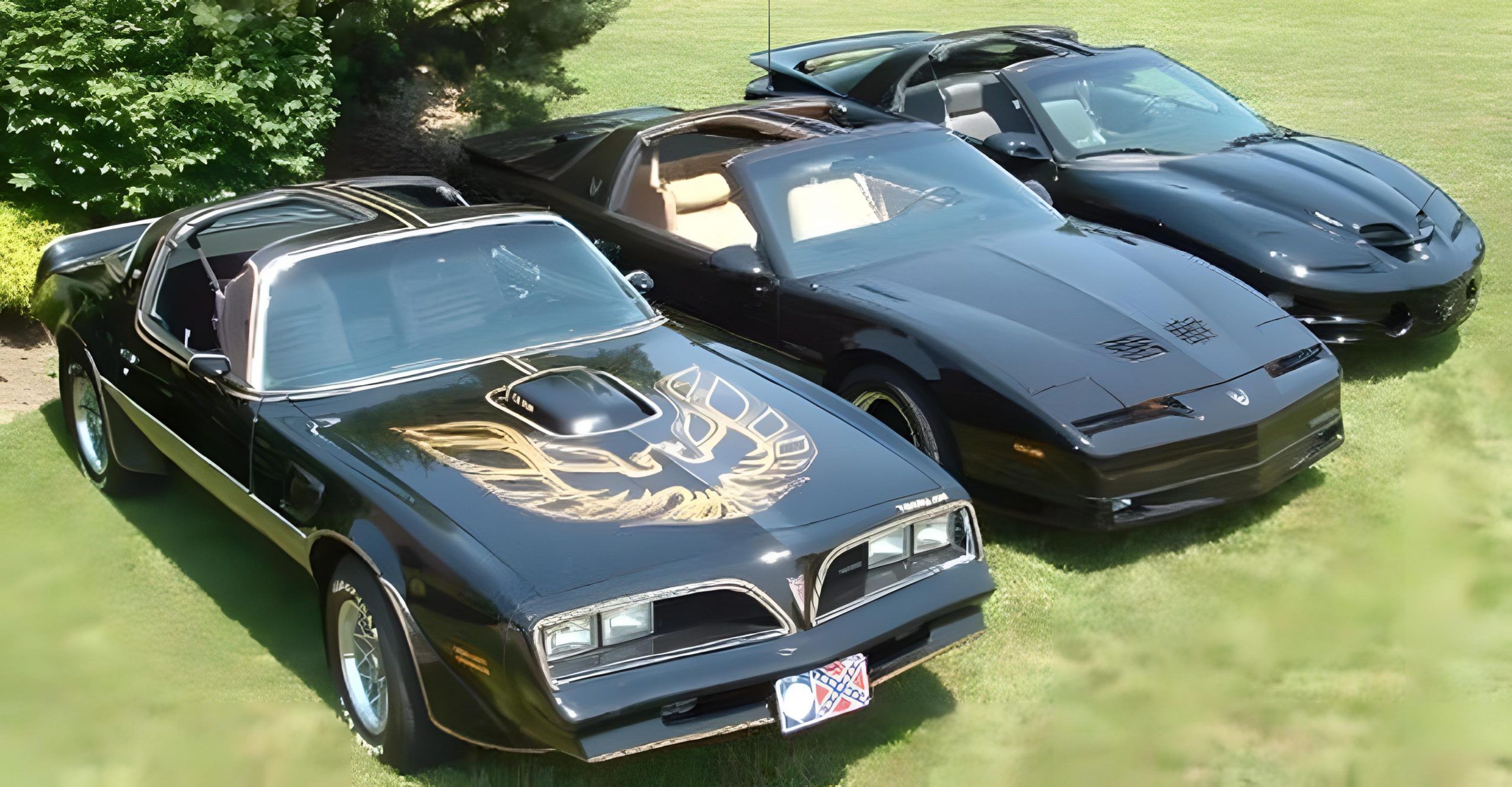
The Trans Am became something far greater than its initial ambitions. In 1976, the black and gold Special Edition became an absolute visual icon, with the massive flaming eagle painted on its hood. A year later, a certain Burt Reynolds pulls it out of the back of a truck at the start of Smokey and the Bandit — and the Trans Am enters the history of world cinema. Nearly 70,000 Trans Ams were sold in 1977. Then came Knight Rider, which transformed a Firebird into a global star in the guise of KITT, the intelligent vehicle with glowing red eyes.
Through the generations, the Firebird evolved and adapted. In 1989, the Trans Am 20th Anniversary, equipped with a 3.8-liter turbocharged V6, became one of the most emblematic and sought-after versions of the line — proof that Pontiac still knew how to inspire dreams when given the chance. The fourth generation, in the 1990s, featured increased performance and bolder design. Firebird production ultimately ended in 2002, due to insufficient sales in a market saturated with sports coupes.
The slow decline, then the brutal fall
Yet the 1970s had marked the beginning of erosion. The 1973 oil crisis shattered the market for fuel-hungry cars. Antipollution standards reduced engine power. GM required all its divisions to share common engines: the engines designed and produced by Pontiac itself gradually disappeared. The brand slowly lost what had distinguished it from internal group competition.
In the 1980s, a restructuring orchestrated by GM merged Pontiac's engineering and production operations with those of other brands. The objective was to cut costs in the face of Japanese competition. The result was devastating for the brand's identity: Pontiac vehicles that increasingly looked like rebadged Chevrolets, sometimes sold at lower prices, creating commercial confusion from which the brand never recovered.
At the peak of its glory, in 1968, Pontiac sold approximately one million vehicles per year. In 2008, the last full year before the shutdown was announced, sales barely exceeded 267,000 units — less than a third of the historical peak. The subprime crisis gravely weakened General Motors, which found itself on the brink of financial collapse. To obtain support from the American government, the manufacturer streamlined its organization. Pontiac was designated "non-essential": too unprofitable, too redundant with Chevrolet, too costly to revive.
On April 27, 2009, GM officially announced the brand's end. The last American Pontiac — a G6, model year 2010 — rolled off the assembly line at the Orion Township plant in Michigan on November 25, 2009. Dealer contracts expired on October 31, 2010. Curtain.
There is a cruel irony in this outcome: just months before the fatal announcement, the Pontiac team unveiled the G8, a true rear-drive sports sedan based on an Australian Holden, and the Solstice roadster — two cars that recalled what the brand had been. Too late. GM had made its decision as part of its restructuring.
The eagle continues to fly
Pontiac disappeared from showrooms, but not from hearts or garages. Collector clubs remain active, auctions for 1960s and 1970s muscle cars reach record heights, and the "arrow point" logo still adorns thousands of jackets, posters, and license plate frames. A brand that defined the modern muscle car, made world cinema roar, and stood toe-to-toe with Ford and Chrysler for decades deserves better than a simple death notice.
If you share this passion for Pontiac's glory days, Brochure Auto has compiled the Pontiac brochures and catalogs available on the site — documents that capture the ambition and aesthetic of an incomparable brand. And if you're looking for user manuals for the models that have stayed in your memory, the Pontiac manuals page on our partner site is there for you.