De Tomaso: The Flamboyant Saga of an Italian-Argentine Rebel
Imagine a wealthy Argentine heir, political exile, who arrives in Modena with a fortune, an extremely wealthy American wife, and just one idea in mind: to defy Enzo Ferrari on his own turf. This scenario worthy of a film is that of Alejandro de Tomaso (1928-2003), founder of the brand bearing his name. A flamboyant brand, sometimes marginal, but always unconventional — and which, in 2025, finally resurrects after two decades of silence.
Birth of an Italo-Argentine dream
The adventure begins in 1959 in the suburbs of Modena, Italy's automotive sports capital. Alejandro, born in Buenos Aires to an Italian father who was minister of agriculture and a mother from a major Spanish family, had fled Juan Perón's regime a few years earlier. A driver for OSCA (the Maserati brothers' team), he meets Elizabeth Haskell — descendant of a co-founder of General Motors — at the 1000 Kilometers of Buenos Aires in 1956. Love at first sight, marriage, Italian exile: the stage is set.
The logo he designs for his young company says everything about its DNA: a T surrounded on a blue and white background, exactly the branding iron that marked the cattle on his Argentine ranch, placed over the colors of the national flag. Italy and Argentina, mechanics and tradition.
Vallelunga and Mangusta: the first flashes of brilliance
During its early years, De Tomaso dedicates itself to racing: Formula Junior single-seaters, then a Formula 1 car entered in 1961 and taken over in 1970 by Frank Williams' team — it was actually at the wheel of a De Tomaso that British driver Piers Courage tragically died at the Dutch GP that year.
But it is in 1963, at the Turin Motor Show, that De Tomaso unveils its first road coupé: the Vallelunga. A small jewel weighing 726 kg using a tubular chassis and a 1.5-liter Ford Cortina four-cylinder. Lightweight, nimble, closer to Lotus philosophy than Ferrari.
Three years later, in 1966, comes the bombshell: the Mangusta. Designed by a certain Giorgetto Giugiaro (then at Ghia), it receives a 4.7-liter Ford V8 and this playful name of "mongoose" — the natural enemy of the cobra, a direct reference to the Shelby AC Cobra. The De Tomaso signature is set: sublime Italian bodywork, sturdy American mechanics. And incidentally: in 1967, Alejandro buys the Ghia coachbuilder, which he will sell to Ford in 1970.
The Pantera, the absolute icon
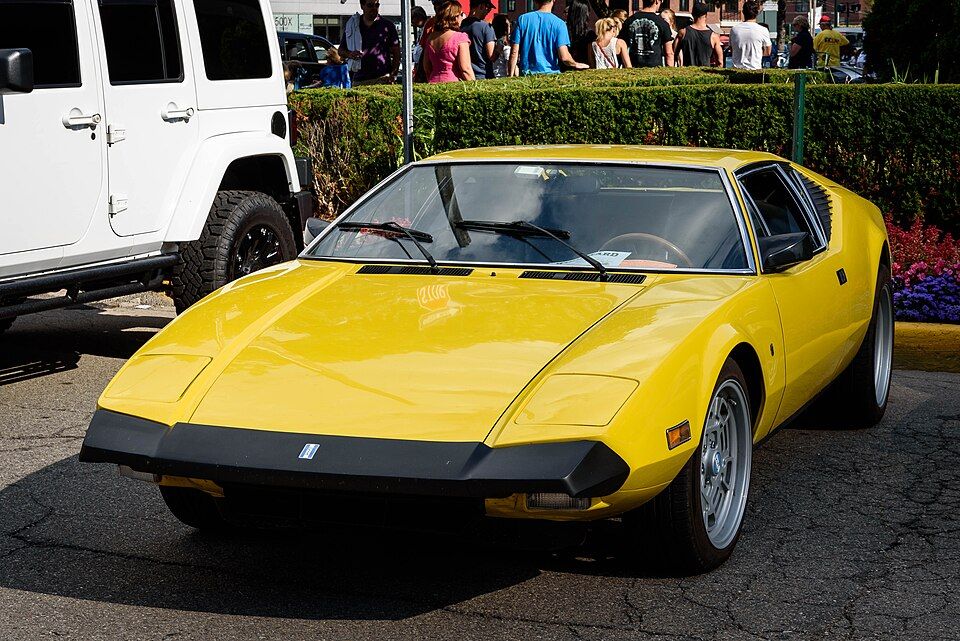
Presented at the New York Motor Show in 1970, produced from 1971, the Pantera is THE model that ushers De Tomaso into legend. Designed by American Tom Tjaarda, it abandons the tubular chassis for a self-supporting steel monocoque — a first for the brand. Under its central engine hood: a 5.8-liter Ford Cleveland V8 with 330 hp, coupled to the same ZF gearbox as the Ford GT40. 0 to 60 mph in 5.5 seconds, over 155 mph.
Distributed in the United States via the Lincoln-Mercury network until 1975, the Pantera seduces approximately 5,500 customers there (Elvis Presley leading the charge, who allegedly fired his revolver at his own, annoyed that it refused to start). In total, approximately 7,260 units will leave the Modena workshops between 1971 and 1992, passing through the GTS, GT5, GT5-S versions, and finally the SI restyled by Marcello Gandini in 1990 (only 41 units).
The Modena empire
In the 1970s, Alejandro plays the voracious industrialist. With the help of the public agency GEPI, he acquires Benelli (1971), Moto Guzzi (1973), Maserati in 1975 (bought from Citroën, in the throes of collapse), then Innocenti (1976) which then produces the new Mini designed by Bertone. Meanwhile, De Tomaso expands its own range with the Deauville (1970), a luxury sedan designed to rival the Jaguar XJ, and the Longchamp (1972), a coupé targeting the Mercedes 450 SLC.
The eclipse, then the resurrection
The story takes a turn for the worse from the 1990s onward. Stroke in 1993, Alejandro partially withdraws. That same year, Maserati is sold to the Fiat group. Innocenti and Moto Guzzi follow. The brand limps along assembling the Simbir 4x4 for Russian UAZ and produces at a trickle the Guara, the last official model released between 1993 and 2004. Alejandro passes away in Modena on May 21, 2003, and the company enters liquidation the following year.
After more than ten years in limbo, it is a Chinese consortium, Consolidated Ideal TeamVenture led by Hong Kong's Norman Choi (already owner of Apollo Automobil), that buys the brand in April 2015. Four years later, in July 2019, De Tomaso creates a sensation at the Goodwood Festival by presenting the P72, a retro supercar paying homage to the 1965 P70 prototype (a joint project by Alejandro and Carroll Shelby).
Six years of development later, the final production version was unveiled in May 2025. 5.0-liter supercharged V8, 700 hp, six-speed manual gearbox, single-piece carbon monocoque, zero screens, fully analog. Limited to 72 units at 750,000 euros each, first deliveries are planned for late 2025. The mongoose has returned from very far away.
And now, time for the brochures!
The De Tomaso story is that of a bold manufacturer who knew how to chart its own course between the giants of Modena. To extend the journey and dive into the technical specifications and period visuals of the brand's models, discover all the De Tomaso brochures available on Brochure Auto. A guaranteed dive into the heart of the golden age of Italo-American automotive history!