NSU: The Forgotten Pioneer Who Gave Its Rotary Engine to the World… and Its Factory to Audi
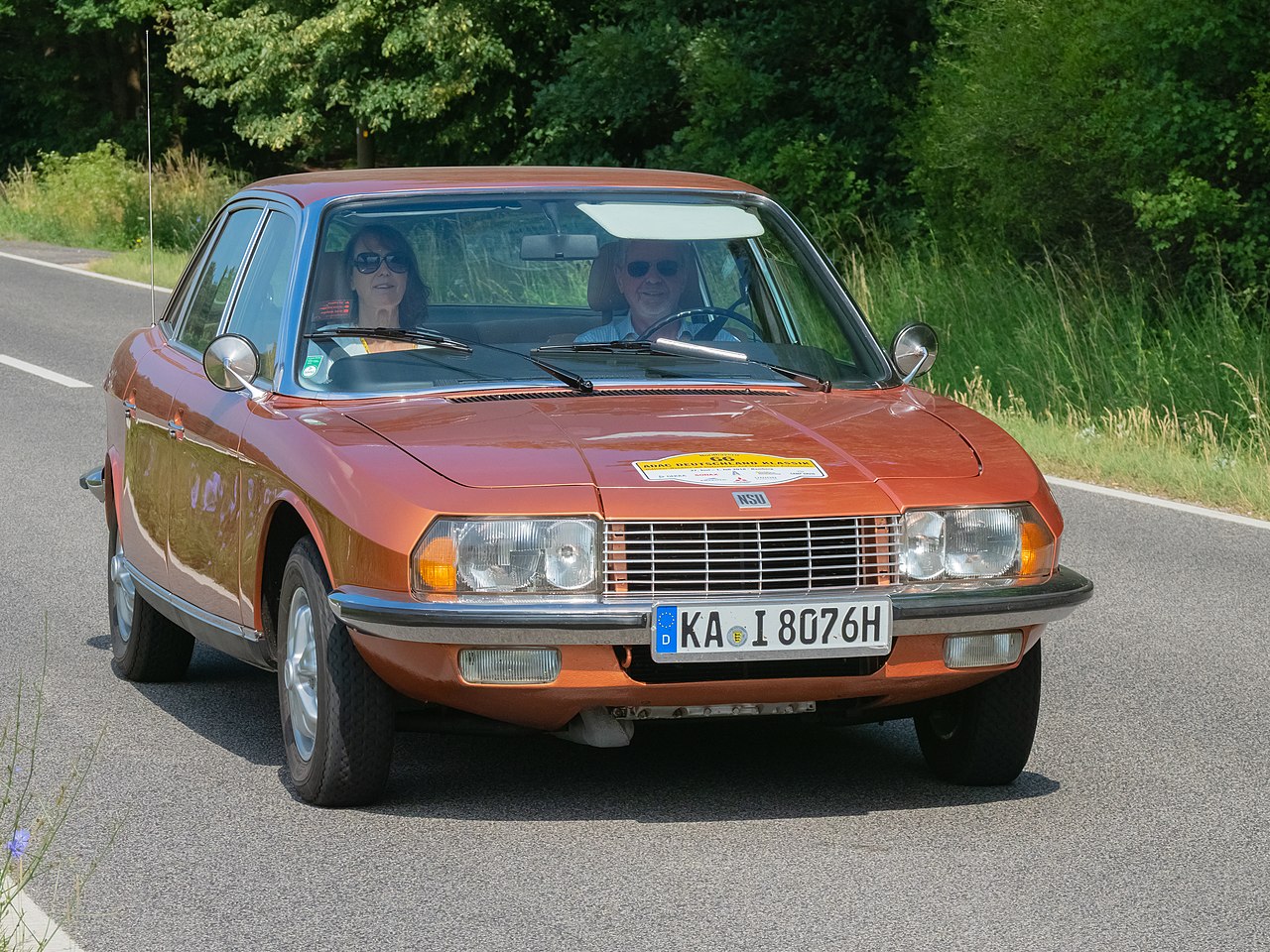
Some brands fade away from being too far ahead of their time; NSU is one of them. In the 1960s, this manufacturer from Neckarsulm, on the banks of the Neckar, gave the world the first production car with a rotary engine, then a sedan so modern it seemed to have stepped out of the following decade. Less than ten years later, the name had disappeared, absorbed by the group that would become Audi. The story of a meteoric rise.
From knitting machines to two-wheelers
It all began in 1873 in Riedlingen, on the Danube, in a workshop that manufactured… knitting machines. Nothing predestined this company for automobiles. In 1880, it relocated to Neckarsulm — from which it would draw its name, NSU — and turned its attention to bicycles, then motorcycles. Success became colossal: by the mid-1950s, NSU was simply the world's leading motorcycle manufacturer, with over 350,000 machines produced in 1955 alone.
But Europe was changing. As families dreamed of four wheels and a roof over their heads, the motorcycle market ran out of steam. NSU then decided to return to automobiles for good, a field it had only briefly explored before the war.
The Prinz, the small car with big ambitions
In September 1957, at the Frankfurt Motor Show, NSU unveiled the Prinz. Produced in series starting in March 1958, this tiny rear-engine sedan with an air-cooled twin-cylinder engine targeted the modest budgets of post-war Germany. Its slogan became famous: "Fahre Prinz und Du bist König," drive a Prinz and you become a king.
The brand didn't stop at utility vehicles. As early as 1958, it entrusted Franco Scaglione at the Turin coachbuilder Bertone with the design of a charming little coupé: the Sport Prinz, produced in 20,831 units until 1968. The Prinz 4 and Prinz 1000 followed, and especially the sporting TT and TTS models, whose handling would prove exceptional in competition. The little TT would achieve no fewer than 29 national touring titles, from Europe to North America.
The bold gamble of the rotary engine
This is where NSU would truly enter history. The brand believed firmly in the engine imagined by engineer Felix Wankel: a mechanism without pistons, in which a triangular rotor spins in a bean-shaped chamber. Compact and lightweight, with an unprecedented smoothness of operation, this rotary engine fascinated engineers around the world.
In 1964, NSU launched the Wankel Spider, a small roadster derived from the Sport Prinz. Its single rotor of 497 cc produced only about fifty horsepower, and barely 2,375 units would leave the factory. The production numbers mattered little: it was the first production car in the world with a rotary engine, and NSU had just opened a path that no one else dared to follow.
The Ro 80, masterpiece and Achilles heel
The pinnacle came with the Ro 80, unveiled at Frankfurt in autumn 1967. Under its bonnet, a twin-rotor engine of 995 cc developing 115 horsepower, transmitted to the front wheels by a semi-automatic gearbox without a clutch pedal. But it was the bodywork that took your breath away: fluid silhouette, sloping bonnet, raised rear end, and especially a drag coefficient (Cx) of 0.355, a figure that many sedans would take fifteen years to match. The Ro 80 was voted Car of the Year 1968, a first for a German car.
Alas, the mechanics did not live up to the promise of the design. The apex seals of the rotor chambers, the famous "apex" seals, wore prematurely: loss of compression, temperamental starting, failures that sometimes occurred after just 25,000 to 50,000 kilometers. NSU replaced engines under warranty, sometimes several times on the same car for certain customers. For a manufacturer of this size, the bill became unbearable. Reinforced seals resolved the problem around 1970, but the reputation was tarnished and the coffers, emptied.
The end of a name, the birth of a giant
On March 10, 1969, NSU merged with Auto Union, the parent company of Audi based in Ingolstadt and already part of the Volkswagen Group. From this union came Audi NSU Auto Union AG, whose headquarters were established… in Neckarsulm. The Ro 80, meanwhile, quietly continued its career until April 19, 1977: 37,398 units in ten years, and the very last model ever badged NSU. In 1985, the company simply adopted the name Audi.
The NSU name faded, but its legacy continues to influence the industry. The Neckarsulm factory is today one of Audi's flagship plants, where the A6, A7, A8 and the sportive R8 are born. The rotary engine, taken under license by numerous manufacturers, would find its longest lineage with Mazda. As for the aerodynamics of the Ro 80, it already heralded the streamlined sedans of the 1980s.
NSU tried everything, dared everything, in just a handful of years. To extend the journey, Brochure Auto preserves the period catalogs of the brand: browse those of the Ro 80 and all the NSU brochures still available, from the little Prinz to the Sport Prinz coupé.
Gallery
Photos © Ermell, ChiemseeMan, Lothar Spurzem / Wikimedia Commons (CC BY-SA 4.0, domaine public, CC BY-SA 2.0 de)
- https://www.audi.com/en/press-releases/futuristic-aerodynamic-stylish-the-nsu-ro-80-15308
- https://www.audi-mediacenter.com/en/press-releases/drive-a-prinz-and-youre-a-king-the-nsu-prinz-15275
- https://en.wikipedia.org/wiki/NSU_Motorenwerke
- https://en.wikipedia.org/wiki/NSU_Ro_80
- https://en.wikipedia.org/wiki/NSU_Prinz