Mazda MX-5: The Complete History of the Little Roadster That Saved the Joy of Driving
There are cars that impress with their power, and others that move you with their lightness. The Mazda MX-5 proudly belongs to the second category. Since 1989, this tiny two-seater roadster has made a bet that everyone thought was doomed from the start: to restore to drivers the pleasure of pure driving, without fuss and without breaking the bank. Thirty-five years, four generations and over a million examples later, it is simply the best-selling two-seater convertible in history — and, a miracle in the age of everything SUV, it still runs. Here is its story, from beginning to end.
Mazda, the outsider who loved the rotary engine
To understand the MX-5, you must first understand Mazda. The Hiroshima manufacturer has never been a manufacturer like any other. While the entire industry bet on the classic piston engine, Mazda stubbornly devoted decades to developing the Wankel rotary engine — a compact, lightweight block, spinning, of unique smoothness. As early as 1967, the Mazda Cosmo became one of the first series cars in the world to be equipped with one, before the legendary RX-7 and then RX-8 made it their signature. "Powered by Rotary": it had become an identity, almost an engineering religion.
The pinnacle of this epic remains engraved in the memory of enthusiasts: in 1991, the Mazda 787B and its four-rotor screaming at full throttle won the 24 Hours of Le Mans, making Mazda the first — and to this day the only — Japanese manufacturer to win the overall classification of the world's greatest endurance race. Remember this mindset well: that of a courageous outsider, obsessed with lightness and willing to take paths that no one else dared to venture. The MX-5 does not have a rotary engine — it is a sensible four-cylinder piston unit — but it was born from exactly the same spirit of independence and passion for driving.
1979-1989: the genesis of a counter-trend idea
The story begins with a conversation. In 1979, in Hiroshima, an American car journalist named Bob Hall slips an idea to Mazda engineering boss Kenichi Yamamoto that has been rattling around in his head: what if we resurrected the light and affordable little roadster, the one once embodied by Lotus Elan and other British cars of the 1960s, before costs and breakdowns swept them all away? In 1982, Yamamoto gives the green light to study the concept. The project is entrusted to chief engineer Toshihiko Hirai, while the styling is drawn, in part in Mazda's California studio, under the direction of Tom Matano.
From this work is born a philosophy that became famous: "jinba ittai", the idea that the car and its driver are one, like a horse and its rider. Everything in the MX-5 stems from this principle: a modest front engine, rear-wheel drive, a weight distribution close to perfect balance, featherweight and a soft top that can be operated with one hand without leaving your seat. Unveiled at the Chicago Motor Show in the spring of 1989, the little Mazda immediately triggers "Miatamania" — from the name Miata, "reward", which it bears in North America (Eunos Roadster in Japan, MX-5 in Europe). Success is immediate, global, and far greater than anything Mazda had dared hope for.
NA (1989-1997): the founder
The first generation carries the internal code NA — the very same found in period catalogs. It is the most endearing of all, with its adorable pop-up headlights that rise at a blink, becoming the absolute emblem of the model. Under the hood, a 1.6-liter four-cylinder with 115 horsepower amply suffices to power a car weighing barely more than 950 kilos. In 1994, a more generous 1.8-liter (around 130 horsepower) joins the lineup, the body is discreetly stiffened and the brakes reinforced.
The NA never shone for its numbers, but for its sensations: steering of rare purity, a small manual gearbox with watchmaker handling and that thrilling feeling that the smallest country road becomes a playground. Quickly special editions flourish that will delight collectors, such as the famous "British Racing Green" from 1991 with fawn leather trim, a knowing nod to the English roadsters whose torch it had taken up. It is this generation that, on its own, resurrects an entire segment believed dead.
NB (1998-2005): refinement
In 1998 comes the second generation, code NB. The change jumps out at you: the pop-up headlights give way to fixed optics, for reasons of cost, weight and pedestrian safety. The silhouette gains in roundness and modernity, the structure in rigidity, without denying the original spirit.
The real turning point comes with the 2001 facelift, which experts call "NB2" — and which catalogs classify as phase 2 (note, the 1999 and 2000 model years are "NB1"). Mazda then offers the 1.8-liter variable valve timing (badged S-VT) that boosts power from 140 to 146 horsepower and gains punch in the rev range; the front face adopts triple-projector optics, equipment and seats are revised. Without ever betraying the simplicity of the original, the NB is a more refined and safer MX-5. It is celebrated in 2000 with a "10th anniversary" edition in such a particular metallic blue shade. Today it is one of the most affordable to buy for those wanting to taste the myth.
NC (2005-2015): accepted weight gain
The third generation, code NC, marks the greatest departure in the lineage. The car widens, lengthens and gains a few kilos — it now weighs around 1,100 kilos — sharing some of its foundations with the rotary-engined sports car RX-8. The mechanics evolve toward 1.8 and 2.0-liter engines, the latter approaching 160 horsepower. Above all, the NC inaugurates a major innovation for the family in 2006: an electric retractable rigid roof (dubbed PRHT), which retracts in about twelve seconds without eating into a single liter of trunk space. The roadster doubles as a proper little coupe-convertible, without losing its liveability.
Long production run notwithstanding, the NC goes through two successive facelifts: a first in 2009 (phase 2 in catalogs), a second in 2012 (phase 3), which refine the front face styling and touch up the running gear. It is the generation of maturity and carefully crafted special editions, often equipped with Bilstein dampers and a locking differential. Purists will reproach it for slight weight gain — a criticism that the next generation would hasten to correct without mercy.
ND (since 2015): a return to roots
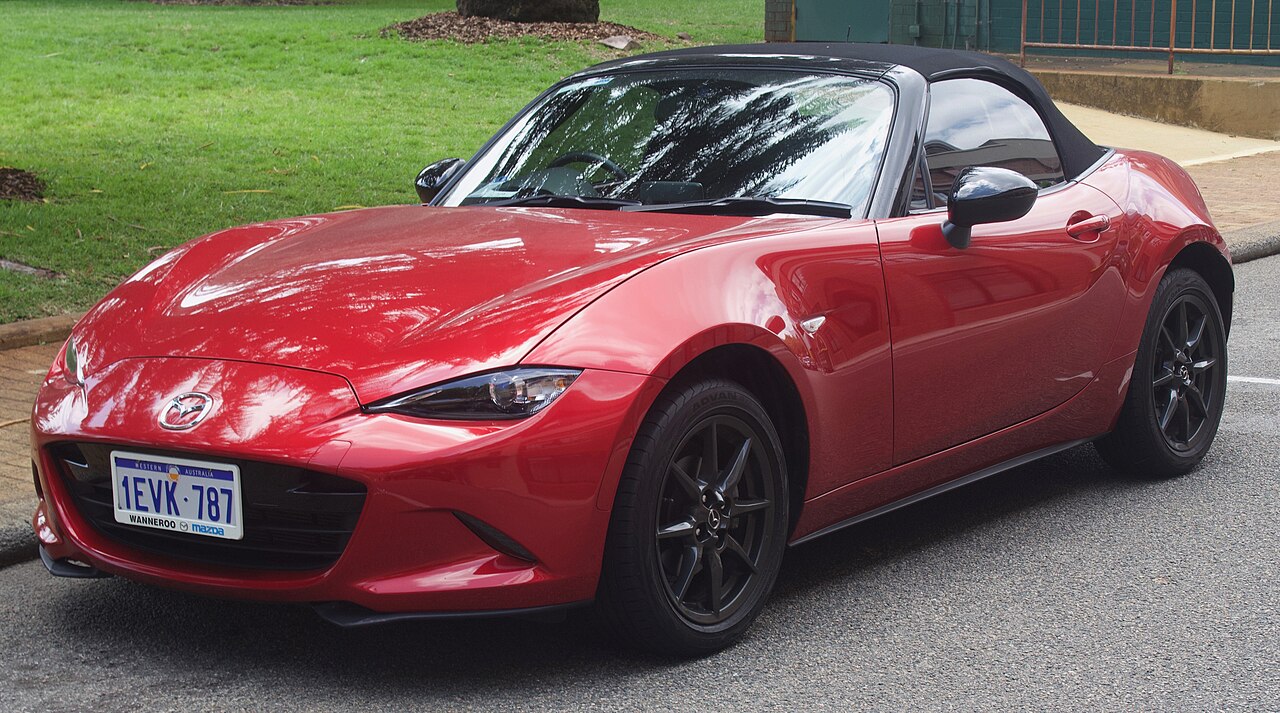
Launched in 2015, the fourth generation, code ND, is a genuine statement of intent. Aware that the MX-5 had put on some weight, Mazda orders a radical diet: the ND drops back under 1,000 kilos in its lightest versions, reclaiming the compact footprint and sharp spirit of the original. Dressed in Mazda's in-house "Kodo" styling language — taut surfaces, a plunging hood, a feline gaze — it trades the big engines for two SkyActiv-G petrol blocks: a 1.5-liter with 131 horsepower with fine mechanics, and a 2.0-liter.
In 2016, an unprecedented variant appears, the MX-5 RF (for "Retractable Fastback"), with a rigid roof that retracts in a spectacular ballet of metal while retaining two targa-style arches — wildly elegant. Then, in 2018, a major update brings the 2.0-liter to 184 horsepower with an extended redline: the little Mazda gains in punch without betraying its philosophy. Special editions continue to inspire dreams, like the "30th anniversary" of 2019 and its Racing Orange shade produced in strictly limited numbers. Constantly tweaked and improved, the ND remains in the catalog today — truly exceptional longevity for a roadster.
From road to controller: a gaming video star
The MX-5 has not only conquered the roads: it also reigns on screens. For nearly thirty years, it has been a staple of racing games, starting with the two giants of the genre that face off console against console — Gran Turismo on PlayStation and Forza on Xbox. From the very first Gran Turismo in 1997, the little Japanese roadster answers the call; the Gran Turismo 4 episode even dedicated a special "Mazda MX-5" edition to it, and the series continues to honor it up to the recent Gran Turismo 7. On the other side, the MX-5 — up to its racing version MX-5 Cup — is a favorite of Forza Motorsport and Forza Horizon, where it has been standard since years.
This virtual success is no accident. Light, playful, easy to tame but demanding to master on the edge, it offers at the controller exactly what it delivers on open road: the pleasure of pure driving, within everyone's budget. Enthusiasts have even turned it into an adage repeated endlessly: "Miata is always the answer" — the Miata is always the right answer. On asphalt as in video games, hard to prove them wrong.
A world record and a whole culture
The numbers are dizzying for a car this unassuming. On April 22, 2016, the MX-5 surpassed one million units produced since 1989 — a milestone no other two-seater roadster has ever reached, which earned it entry into the Guinness Book of Records as the best-selling two-seater sports convertible of all time. But its influence far exceeds the statistics. You find it everywhere: on small European roads on Sunday mornings, in countless enthusiast clubs, and above all on the track, where it has become one of the most widespread amateur race cars on the planet, the backbone of entire single-make championships.
Its secret has never changed from one generation to the next: it does not seek to impress, but to make you smile. Where so many sports cars bet on horsepower and lap times, the little Mazda reminds us that a well-negotiated corner, hair in the wind and manual gearbox in hand, brings a happiness that raw power will never replace. As the future of small thermal sports cars is questioned and electrification reshuffles the deck, the MX-5 stands as a precious exception — living proof that a car can be modern, desirable and faithful to an idea thirty-five years old.
From the NA with its pop-up headlights to today's ND, the MX-5 has crossed the ages without ever betraying itself. To continue the journey generation by generation, discover on Brochure Auto the period brochures of the Mazda MX-5 available for free download — from the first in 1989 to the latest to date, one of the finest little pleasures of motoring to leaf through like a family album.
Gallery
Photos © StepInTheMirror (domaine public), Rutger van der Maar (CC BY 2.0), John Robert McPherson (CC0), IFCAR (domaine public), Ethan Llamas (CC BY / CC BY-SA 4.0) / Wikimedia Commons
- https://fr.wikipedia.org/wiki/Mazda_MX-5
- https://en.wikipedia.org/wiki/Mazda_MX-5_(NA)
- https://en.wikipedia.org/wiki/Mazda_MX-5_(NB)
- https://en.wikipedia.org/wiki/Mazda_MX-5_(NC)
- https://news.mazdausa.com/2016-04-24-Mazda-Produces-One-Millionth-Mazda-MX-5
- https://gran-turismo.fandom.com/wiki/Mazda_Roadster