Tucker 48: The Car "of the Future" That Defied the Powerful… and Lost
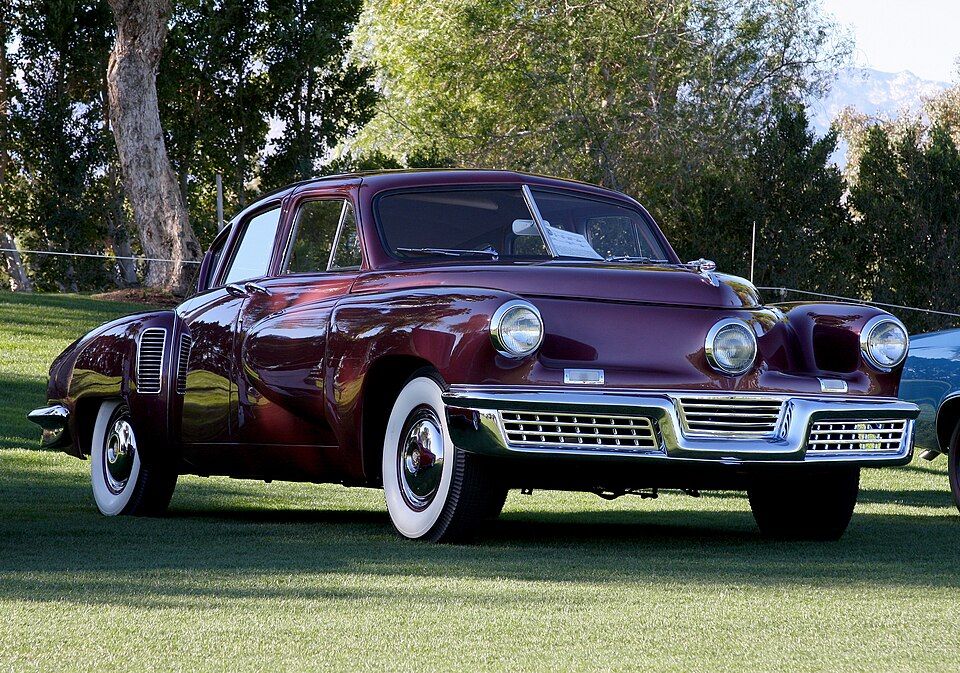
photo credit Rex Gray
Imagine a post-war American sedan equipped with seat belts, a padded dashboard, a retractable windshield in case of impact, a safety roll bar integrated into the body, and a third headlight that pivots in the direction of your gaze. A car claiming 192 km/h as top speed according to manufacturer data, powered by a helicopter engine mounted at the rear — in 1948. Hard to believe ? Yet this machine truly existed — all 51 examples of it. This is the story of the Tucker 48, and it's one of the most beautiful tragedies in American automotive history.
Preston Tucker, the man who saw too far ahead
Born September 21, 1903 in Capac, Michigan, Preston Thomas Tucker is, in the truest sense of the term, a child of the automobile. Michigan is Detroit, the cradle of the Big Three — General Motors, Ford, Chrysler. Tucker grew up in this world, learned to drive at 11 years old, resold cars as a teenager, and worked his way through the major houses : Cadillac, Ford, Studebaker, Chrysler, Dodge. He learned the trade from every angle, absorbing its codes… and its limitations.
During World War II, Tucker developed a rotating combat turret for the military — the "Tucker Turret" — ultimately adopted on tanks and aircraft. When peace returned in 1945, the American automotive industry was coasting : the Big Three resumed their pre-war lines on technical bases dating from the 1930s. Tucker, however, saw a historic window. Post-war America wanted something new, modern, safe. He was going to give it to them.
The car that astounded, from bumper to third headlight
In 1946, Tucker founded his company in Chicago and rented a massive factory formerly dedicated to aircraft engine manufacturing. He recruited several designers, including Alex Tremulis, and a first prototype was presented on June 19, 1947 in front of more than 3,000 guests and the world press. The effect was immediate : nobody had ever seen anything like it.
The Tucker 48 — named in reference to the planned year of commercialization — is 5.56 meters long, 2 meters wide, and features a streamlined silhouette that quickly earned it the popular nickname "Tucker Torpedo". The body integrated a safety roll bar in the roof. The doors rose into the roof panel to facilitate entry. And at the center of the front shield sat a third orientable headlight, which activated whenever the steering wheel turned more than 10 degrees to illuminate the inside of curves — an innovation so ahead of its time that, according to Wikipedia, 17 American states had laws at the time limiting vehicles to two headlights.
Under the rear hood — because yes, the engine was mounted at the rear, a rear-mounted architecture extremely rare on an American sedan of that era —, Tucker had to improvise. His own 9.6-liter block proved too complex to develop within the timeframe. Salvation came from Air Cooled Motors : they offered a 5.475-liter flat-six aluminum engine, derived from Franklin helicopter engines. Adapted with water cooling and two Stromberg carburetors, it was mounted at the rear on a sub-frame removable in half an hour. This engine produced 166 horsepower — enough to claim 192 km/h top speed and a 0 to 100 km/h time of ten seconds. Impressive performance for a family sedan of nearly two tons in 1948.
Safety ahead of its time — and that troubled people
What strikes most about the Tucker 48 is its obsession with passive safety. In the 1940s, major American manufacturers produced cars designed like iron locomotives, with not the slightest consideration for what happened to occupants in a crash. Tucker, however, insisted on : safety glass windshield designed to eject cleanly in an accident, padded dashboard and door panels, body structure with reinforced perimeter, steering column offset behind the front axle. And, tellingly, a "crash chamber" — an empty cavity in front of the passenger seat, free of any obstacles, designed as a refuge zone in case of frontal collision.
These innovations, which would become standard decades later, deeply troubled the Big Three. A safer and more modern car coming from a small Chicago factory was a public slap in the face to Detroit.
The conspiracy, the trial, and the fall
In the summer of 1948, before production was even fully underway, the Securities and Exchange Commission (SEC) opened an investigation against Preston Tucker for securities fraud and false advertising. A sensational trial followed in 1949, where the prosecution attempted to prove that Tucker never intended to build a car — just to embezzle funds. Meanwhile, steel suppliers backed out, the press amplified the scandal, and investors fled.
Tucker persisted. He had his 50 cars parked in front of the courthouse to show the jury that production had indeed taken place. The jury even insisted on test driving them. In January 1950, Tucker was acquitted of all charges. But the factory had already closed on March 3, 1949, converted into public housing. The Tucker Car Corporation was bankrupt. Fifteen hundred employees found themselves out of work.
Preston Tucker, exhausted and ruined, died on December 26, 1956, at 53 years old, from lung cancer. He would never see his reputation fully restored during his lifetime.
A cursed man among the cursed
Tucker's story resonates painfully with other destinies that Brochure Auto readers know well. Malcolm Bricklin, with his Bricklin SV-1 in 1974, and John DeLorean, with his DMC-12 in 1981, weathered very similar storms : the ambition to defy established major manufacturers, a technically avant-garde car, financing problems, government investigations, a publicized trial, and premature closure. None of the three were convicted. All three saw their company die before the verdict. It's probably not a coincidence.
About forty survivors and millions at auction
Of the 51 examples produced, collector records estimate that around forty to 47 cars still exist — a remarkable survival rate for a post-war car. Most are displayed in American museums. A few still circulate among passionate collectors : Francis Ford Coppola owns one, displayed on his vineyard estate in California. Coppola directed in 1988 the film Tucker : The Man and His Dream, with Jeff Bridges in the role of Preston Tucker — a co-production with George Lucas, himself a former owner of an example.
Auction prices are staggering : according to recorded transactions, a Tucker 48 sells for between 1.3 and over 2.2 million dollars. By comparison, Preston Tucker intended to sell it for less than 2,000 dollars at launch.
The car of the future, still there
The Tucker 48 is not merely a curiosity for rare car enthusiasts. It's a manifesto : proof that passive safety, aerodynamics, rear-engine architecture, and technological innovations were achievable as early as 1948, if one made the effort. And proof, too, that disruption troubles people — sometimes to the point of triggering legal proceedings.
Want to browse the original brochures of this American legend produced in just 51 examples ? They're waiting for you on Brochure Auto.